



Is your business losing money simply because invoices are being sent late, ignored, or never properly followed up?
For many Australian SMEs, the issue goes beyond overdue invoices. An inconsistent accounts receivable process slows cash flow, tightens supplier commitments and makes strategic decisions reactive rather than planned. Even profitable businesses can struggle with delayed collections.
Late payments are a common financial pressure for Australian SMEs. Directors spend valuable time chasing invoices, resolving disputes and monitoring debtor balances instead of focusing on operations and growth. Still, most businesses manage receivables in-house with limited systems, no dedicated team and no formal process.
The solution? Accounts receivable outsourcing.
By outsourcing accounts receivable, SMEs can improve collections, strengthen AR cash flow and reduce overheads through structured, end-to-end ar receivable process management.
This blog covers:
- The most common accounts receivable problems faced by Australian SMEs
- How outsourcing improves AR cash flow and reduces debtor days
- Cost comparison between in-house receivables teams and AR outsourcing
- The role of structured processes and automation in collections management
- Scalability, compliance control and operational advantages of outsourcing AR services
Common Accounts Receivable Problems Facing Australian SMEs
Most SMEs experience the same recurring issues regardless of industry or size:
| Common AR Problem | Business Impact | How Outsourcing Helps |
|---|---|---|
| Delayed or inconsistent invoicing | Slow cash inflow, extended debtor days | Structured billing with 24–48-hour turnaround |
| No formal follow-up process | Invoices go unpaid or forgotten | Automated reminders and escalation procedures |
| Missing purchase order references | Invoice disputes and payment delays | Pre-billing checks and credit approval controls |
| Poor debtor visibility | No clear picture of outstanding balances | Real-time dashboards and regular debtor reporting |
| Reconciliation errors | Inaccurate records, audit risk | Dedicated reconciliation managed by specialists |
| Too much management time on collections | Leadership distracted from core business | All follow-up handled externally |
Knowing which of these applies to your business is the starting point. Here is how outsourcing addresses each of them.
Stronger Cash Flow and Faster Collections
Cash flow improvement is the primary reason many SMEs consider accounts receivable outsourcing. Delays in invoicing or weak follow-up procedures often increase debtor days.
By outsourcing accounts receivable, businesses gain structured follow-up systems and consistent billing cycles.
How It Improves AR Cash Flow:
A specialist provider manages the end-to-end accounts receivable process, including:
- Timely invoice generation
- Structured reminder schedules
- Escalation procedures
- Payment reconciliation
This approach helps:
- Improve cash flow with accounts receivable outsourcing
- Reduce overdue payments with outsourcing
- Shorten Days Sales Outstanding (DSO)
Improving cash flow through outsourcing AR creates predictable working capital, which supports payroll, supplier payments and investment decisions.
Lower Operational Cost Without Hiring In-House Staff
Hiring an internal receivables team involves salary, superannuation, training and software licensing cost. For many SMEs, this is not cost-effective.
Accounts receivable outsourcing Australia allows businesses to pay for service-based support instead of fixed employment expenses.
Accounts Receivable Outsourcing Cost Considerations:
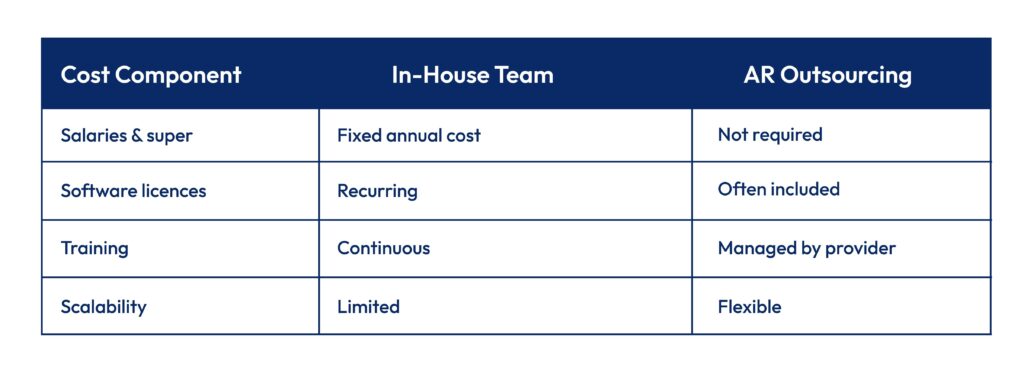
Cost savings through AR outsourcing often become clear when volumes fluctuate. Businesses can scale services up or down without restructuring staff.
Access to Expertise and Structured Processes
Many SMEs struggle because the accounts receivable process lacks formal controls.
Outsourcing accounts receivable services follow defined accounts receivable process steps that reduce errors and disputes.
What a Structured Accounts Receivable Process Includes:
- Clear billing process in accounts receivable
- Credit checks and approval controls
- Regular debtor reporting
- Reconciliation procedures
- Dispute management
Professional teams also identify accounts receivable problems and solutions early, such as:
- Incorrect invoicing
- Missing purchase order references
- Delayed approval cycles
Outsourcing accounts receivable management ensures consistency across all these steps.
Technology and Automated Systems
Manual tracking increases the risk of missed follow-ups. Modern providers use automated accounts receivable processing tools to improve accuracy and reporting.
Benefits of Automated Accounts Receivable Processing:
- Real-time debtor dashboards
- Automated reminder sequences
- Reduced manual errors
- Faster reconciliation
Virtual accounts receivable outsourcing also allows remote system access, ensuring directors retain visibility over outstanding balances.
Automation improves efficiency without removing control from the business.
Scalability for Growing SMEs
Growth often exposes weaknesses in the accounts receivable process. Increased sales volume means more invoices and more follow-ups.
Accounts receivable outsourcing for SMEs offers flexibility. Services can expand during growth periods and adjust during quieter cycles.
This is particularly helpful for:
- Seasonal industries
- Rapidly scaling businesses
- Companies entering new markets
Outsourcing AR services for SMEs provide stability during change without increasing fixed overheads.
Improved Focus on Core Operations
Chasing payments consumes management time. When directors manage debtor calls personally, strategic planning suffers.
One of the key benefits of outsourcing accounts receivable is operational clarity.
By choosing to outsource AR services, businesses free up internal resources for:
- Business development
- Financial forecasting
- Customer service
- Process improvement
This is one of the strongest advantages of AR outsourcing for leadership teams.
Reduced Risk and Stronger Compliance Controls
Accurate invoicing and record-keeping are essential for audit readiness and reporting in Australia.
A well-managed accounts receivable process supports accurate financial statements and reduces compliance risk.
Professional accounts receivable solutions ensure:
- Proper documentation
- Clear audit trails
- Timely reporting
As a pro tip, the accounts payable and receivable process should align. When both cycles are structured, overall working capital management improves significantly.
AR Outsourcing: A Practical Before and After Comparison
| Scenario | Before | After Outsource Accounts Receivable |
|---|---|---|
| Invoice delays | 7–10 days | 24–48 hours |
| Average debtor days | 55 days | 35–40 days |
| Management time on follow-ups | High | Minimal |
| Reporting visibility | Basic spreadsheets | Automated dashboards |
This example shows why many directors ask: why outsource accounts receivable? The answer often lies in measurable operational improvements.
Conclusion
Accounts receivable outsourcing enables Australian SMEs to strengthen cash control, reduce overdue accounts and introduce consistency into their receivables function. With structured processes and better visibility, businesses can manage working capital more confidently while reducing operational pressure.
For companies assessing their receivables approach, Outbooks provides structured support to Australian SMEs. If internal processes are affecting cash stability or growth planning, exploring external expertise may offer a practical and measured solution.
Need better control over your receivables? Call 0451 320 102 or email info@outbooks.com.au to discuss your requirements.
FAQs

Parul is a content specialist with expertise in accounting industry. Her writing covers a wide range of domains such as, Accounts Payable, Accounts Receivables, Bookkeeping and more. She writes well-researched content and has a strong understanding of accounting terms and industry-specific terminologies. As a subject matter expert, she simplifies complex concepts into clear, practical insights, helping businesses with accurate tips and solutions to make informed decisions.