
Outsourced management accounts are regular financial reports prepared by an external accounting provider. They help businesses track performance, control costs and make informed decisions. The pack usually covers a profit and loss statement, a balance sheet and cash flow information, plus any extra analysis the business asks for.
The reports and level of detail depend on the business’s size, reporting needs and the information available. Some businesses need a concise monthly summary, while others require more detailed breakdowns of revenue, expenses or individual business areas.
This guide explains which reports outsourced management accounts can include, how often businesses can prepare them, what deliverables to expect and which records are needed to produce useful reports.
Key takeaways
- Outsourced management accounts provide financial reports to assess profitability, financial position and cash flow.
- Monthly or quarterly reporting helps businesses monitor performance and respond to changes in income and expenses.
- Additional reports can compare budgets with actual results and break down revenue or costs by business area.
- Up-to-date bookkeeping, reconciled accounts and relevant supporting records help ensure reliable reports.
- Reviewing balances, financial variances and unexplained changes helps businesses identify issues before making decisions.
What reports are included in Outsourced Management Accounts?
Outsourced management accounts can include a profit and loss statement, balance sheet and cash flow report or forecast, depending on the agreed scope. These reports help business owners and managers assess financial performance, understand their financial position and plan for upcoming payments.
The exact report pack varies by provider and engagement. Some businesses need only the core financial statements, while others require additional analysis to answer specific management questions.
The Core Reports: Profit and Loss, Balance Sheet and Cash Flow Forecast
The three core reports provide different views of the business’s finances:
| Report | What it shows | How businesses use it |
|---|---|---|
| Profit and loss statement | Revenue, expenses and profit or loss over a reporting period | Review income, operating costs and profitability |
| Balance sheet | Assets, liabilities and equity at a particular date | Assess the business’s financial position and obligations |
| Cash flow report or forecast | Cash movements or expected receipts and payments, depending on the report | Monitor available cash and plan for upcoming commitments |
These reports answer different questions. The profit and loss statement shows performance over a period, while the balance sheet records the financial position on a specific date. A cash flow report records cash movements, whereas a forecast estimates future cash movements based on its assumptions and inputs.
Businesses should confirm whether the agreed pack includes historical cash flow reporting, a forward-looking forecast or both. These deliverables serve different purposes and require different information.
Additional Reports added to suit the business
Additional reports can provide more detail about particular costs, revenue sources or operational areas. Their availability depends on the business’s reporting requirements, the accounting records and the provider’s agreed scope.
Depending on the available data, supplementary reports may include:
- Budget versus Actual Reports: Compare recorded income and expenses with budgeted figures to identify significant differences.
- Revenue Breakdowns: Separate income by product, service, customer group or business unit where records support these categories.
- Expense Analysis: Review spending across selected expense categories to identify changes that need further investigation.
- Accounts receivable reports: Review outstanding customer invoices and their payment status.
- Accounts Payable Reports: Review unpaid supplier invoices and upcoming payment commitments.
- Key performance indicators (KPIs): Monitor selected financial measures, such as gross profit margin or operating costs as a proportion of revenue.
Not every management accounts pack includes all these reports. Businesses should agree on the required breakdowns and performance measures before preparation begins.
How often should Outsourced Management Accounts be prepared?
Outsourced management accounts can be prepared monthly or quarterly, depending on how frequently the business needs financial information and whether its records are ready for reporting. Monthly reporting provides more frequent updates, while quarterly reporting can suit businesses that need less frequent reviews.
The right frequency depends on the pace of business activity, the complexity of its finances and the decisions management needs to make.
Monthly or Quarterly Management Accounts: How to choose?
Monthly reporting can help businesses identify changes in revenue, expenses and cash requirements before several months of activity accumulate. It can be useful when management regularly reviews performance, monitors costs or makes decisions based on recent figures.
Quarterly reporting may be suitable for businesses with relatively stable activity and fewer requirements for frequent financial reviews. However, less frequent reports can delay the identification of unexpected cost increases or changes in performance.
Consider these factors when selecting a reporting frequency:
- Business activity: Frequent changes in sales, costs or staffing may support monthly reporting.
- Decision-making needs: Businesses that review financial performance each month may need reports on the same schedule.
- Record readiness: Transactions, invoices and reconciliations need to be sufficiently up to date for the selected reporting period.
- Reporting costs and resources: The business should consider the effort required to maintain records and prepare each report pack.
The reporting schedule should reflect the business’s needs and the agreed preparation process. A consistent schedule also helps managers compare results across periods.
What are the Deliverables of Outsourced Management Accounts?
The main deliverable is a management accounts pack containing the agreed reports and supporting financial analysis. Depending on the engagement, the pack may include commentary, comparisons, supporting schedules or other reporting components.
Before appointing a provider, businesses should confirm what the pack contains, how it will be presented and which additional tasks are included in the service.
The report pack and its format
A management accounts pack should present financial information in a format that managers can understand and use. The agreed format may include summary reports, detailed schedules or comparisons with earlier periods.
The deliverables may include:
- Profit and loss statement and balance sheet.
- Cash flow report or forecast, where included in the agreed scope.
- Budget-versus-actual comparisons, where relevant data is available.
- Supporting schedules for selected income or expense categories.
- Explanatory notes or commentary on significant changes, if agreed.
Businesses should specify their preferred reporting format and level of detail before preparation starts. For instance, a business with several departments may need separate expense breakdowns, while a smaller business may require a shorter summary of its financial results.
Software and reporting add-ons
Management accounts can be prepared using accounting software and other reporting tools supported by the provider and the business’s existing systems. The software used depends on the current bookkeeping setup, the records available and the agreed workflow.
Businesses using MYOB, Xero or QuickBooks Online should confirm that the provider can work with their accounting system and produce the required reports from the available records.
Additional reporting components may include customised categories, selected KPI summaries or budget comparisons. These should be agreed in advance rather than assumed to be standard inclusions.
A software connection alone does not guarantee that every requested report can be produced. The underlying records must contain the necessary detail, and reporting categories need to be consistent.
Query handling and quality review
A reporting process may include queries about missing documents, unusual transactions, unreconciled balances or differences between accounting records. Resolving these issues helps improve the reliability of the final pack.
The exact review and query-handling process depends on the provider’s procedures and the engagement terms. Businesses should establish who will respond to questions, who will review the completed reports and how corrections will be communicated.
Before confirming an outsourced management accounts service, ask whether the agreed scope includes:
- Checks for missing or inconsistent financial information.
- Queries about unusual transactions or unreconciled balances.
- Review of report figures before delivery.
- Corrections when an error is identified.
- Commentary on significant movements, where required.
These points help set expectations and distinguish report preparation from additional financial analysis or advisory work.
What information is needed to prepare Management Accounts?
Management accounts require up-to-date financial records, relevant supporting documents and an agreed reporting structure. The quality of the reports depends on the completeness and accuracy of the information provided.
The precise requirements vary according to the reports requested, the accounting system and the complexity of the business.
Up-to-date bookkeeping and reconciliations
Bookkeeping records provide the transactions used to prepare management accounts. If transactions are missing, incorrectly categorised or unreconciled, the resulting reports may not reflect the business’s actual financial position.
The information required may include:
- Recorded sales and purchase transactions.
- Bank and credit card statements, with reconciliations completed where possible.
- Customer invoices and records of payments received.
- Supplier invoices and records of payments made.
- Payroll or other operating cost information relevant to the reports.
- Details of unusual transactions, adjustments or outstanding queries.
The quality of these records affects the reliability of the final reports. The following issues can make management accounts less accurate:
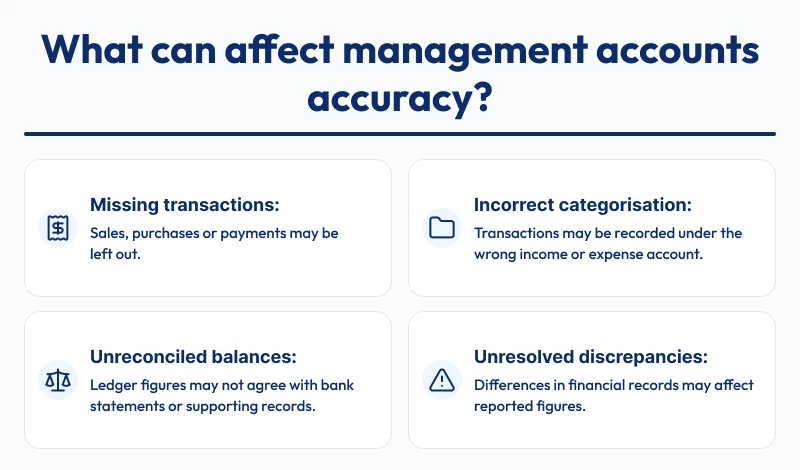
Addressing these issues before finalising the reports helps ensure management receives more reliable financial information.
Budget, chart of accounts and format preferences
Additional information may be needed when the business requests budget comparisons, department-level reporting or specific performance measures.
Depending on the agreed scope, this may include:
- Budget or forecast figures: Needed to compare actual performance with planned results.
- Chart of accounts: Helps maintain consistent income and expense categories.
- Reporting preferences: Defines the layout, level of detail and categories required in the pack.
- Business-unit information: Supports separate reporting for departments, locations, projects or other divisions where transactions are recorded accordingly.
- Prior-period figures: Supports comparisons with previous months or quarters.
Providing these details before preparation helps reduce avoidable queries and keeps the reports consistent across periods.
How do you check Management Accounts for accuracy?
Businesses should check whether the management accounts agree with the underlying records, cover the correct period and explain significant differences. Reviewing the pack before using it can help identify errors, incomplete information and unusual movements that need investigation.
A practical review should cover the following points:
- Confirm the reporting period: Check that the reports include the correct dates and transactions.
- Review key balances: Compare important figures with the accounting records and reconciliations.
- Check unusual movements: Investigate unexpected changes in revenue, expenses, margins or cash balances.
- Review comparisons: Confirm that budgets and prior-period figures use consistent categories and periods.
- Raise discrepancies: Ask the preparer to clarify unexplained differences or correct identified errors.
- Confirm outstanding issues: Check whether any missing records, assumptions or unresolved queries could affect the figures.
A review should not stop at confirming that totals appear reasonable. A report can add up correctly while still containing a misclassified transaction or incomplete information. Reviewing significant movements and checking supporting records helps managers use the figures with greater confidence.
Conclusion
Outsourced management accounts can give businesses a regular view of financial performance through core reports, supporting schedules and agreed analysis. The report types, reporting frequency and deliverables should reflect the decisions management needs to make and the information available.
Before choosing a provider, confirm the contents of the report pack, the accounting software supported, the information required and the process for handling queries and reviewing figures. Clear expectations help businesses receive management accounts that support practical financial decisions.
If you are considering outsourced management accounts for your business, book a consultation with Outbooks or email info@outbooks.com.au to discuss your requirements.
Frequently asked questions
1. How are management accounts different from financial statements?
Management accounts help business owners and managers monitor performance and support internal decisions. Financial statements present a business’s financial performance and position for formal reporting purposes. Their format, detail and preparation requirements depend on their intended use.
2. Who needs management accounts?
Business owners, directors, managers and finance teams can use management accounts to review revenue, costs, profit and cash flow. Accounting and bookkeeping firms may also prepare management accounts for their business clients. The level of detail should reflect the business’s reporting needs.
3. Can management accounts show which products or projects are most profitable?
Yes, management accounts can help compare the revenue and costs associated with products, services or projects when the underlying records contain sufficient detail. The analysis depends on how consistently income, direct costs and relevant overheads are assigned to each area.
4. What is the difference between bookkeeping and management accounting?
Bookkeeping records and organises financial transactions. Management accounting uses financial information to review performance, examine costs and support business decisions. Accurate and up-to-date bookkeeping provides the foundation for reliable management accounts.
5. Are management accounts useful for small businesses?
Yes, management accounts can help small businesses monitor operating costs, review margins and plan for cash requirements. The reports do not need to be complex. Their frequency and level of detail should reflect the business’s needs and the quality of its available records.
6. What is management accounts variance analysis?
Management accounts variance analysis compares actual financial results with budgeted, forecast or previous-period figures. For example, a business may investigate why operating expenses exceeded the budget. The analysis is more useful when the figures are accurate and the comparison uses consistent categories and periods.
7. Can management accounts help a business plan its cash flow?
Yes, management accounts can support cash flow planning by showing current financial results and, where included, expected receipts and payments. Information about customer payments, supplier commitments and upcoming expenses can help identify potential cash shortfalls. Forecasts remain estimates, so actual cash movements may differ from projected figures.