



A hospitality business in Surfers Paradise manages seasonal transaction spikes. A construction business around Robina handles payment claims and subcontractor invoices across multiple jobs. A retail business in Southport reconciles income from point-of-sale, online platforms and direct invoicing at the same time.
The Gold Coast economy passed $55 billion in 2026, growing 25% since 2020/21 and becoming Australia’s largest non-capital city economy. Tourism, manufacturing and construction remain its core industries, with technology, professional services and health sectors growing alongside them. Each creates a different bookkeeping load.
For Gold Coast businesses looking to outsource accounting and bookkeeping together, the same provider can typically cover both.
When transaction volume exceeds internal capacity, that standard slips and a backlog builds. This guide covers what outsourcing bookkeeping includes, what an in-house hire costs and how to choose the right setup
Key takeaways
- Gold Coast SMEs in tourism, hospitality and construction face workload patterns that fixed internal capacity cannot consistently match.
- According to Indeed, the average bookkeeper salary in Gold Coast QLD is $67,557 per year, before additional employer on-costs such as leave entitlements and software licences are added
- Outsourcing bookkeeping covers bank reconciliation, accounts payable, accounts receivable, payroll processing and management reporting
- Most providers work across Xero, MYOB and QuickBooks so businesses keep their existing software without switching systems
- The right engagement model depends on transaction volume, workload consistency and how much direct oversight the business owner wants to retain
Why Bookkeeping becomes harder as Gold Coast SMEs grow?
Tourism has a large share of Gold Coast business activity, and the latest figures confirm just how concentrated that activity has become. That seasonal rhythm shapes bookkeeping pressure in a way that does not apply the same way in most other Australian cities.
A consistent pattern shows up before that pressure becomes a real problem. These patterns show up across Gold Coast industries, but the warning signs look the same regardless of sector.
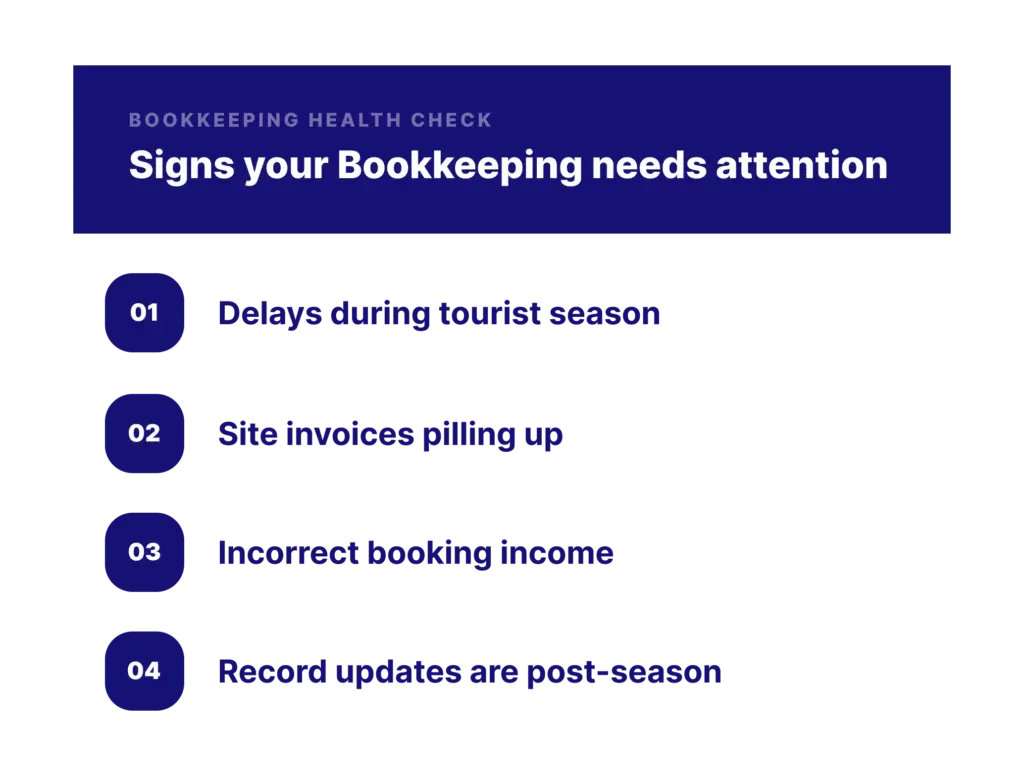
Here is how each industry creates that pressure and where records typically start to slip.
Tourism and hospitality
The Gold Coast’s visitor economy reached $8.9 billion in 2025, with 14.4 million visitors recorded for the year, according to Tourism Research Australia data published by Experience Gold Coast. Domestic visitors alone contributed $7.5 billion in expenditure.
That scale of activity is not spread evenly across the year. Transaction volume during school holidays and major events rises faster than manual reconciliation can keep pace with and the gap shows up once the season ends.
Construction and Residential Development
Construction remains one of the Gold Coast’s most active sectors, with multiple residential and commercial projects running concurrently across suburbs including Robina, Coomera and the Yatala-Stapylton corridor.
With this level of activity, multiple job sites running concurrently is common rather than the exception. Each site produces its own invoices and subcontractor claims on separate schedules and consolidating them into one accurate set of records takes more time than most businesses have available.
| Industry | Workload pattern | Where records become inaccurate |
|---|---|---|
| Tourism and hospitality | Revenue spikes across school holidays, summer and events | Reconciliation deferred during peak periods; backlog follows |
| Construction and trade | Multiple concurrent projects with staggered invoices and payment claims | Volume across jobs grows faster than the time available to process it |
| Retail and professional services | Income from point-of-sale, online platforms and direct invoicing simultaneously | Financial data sits across multiple systems with no single consolidated view |
Each pattern differs in cause but produces the same result: records that were manageable at an earlier stage become a growing liability as transaction volume increases.
Also Read: 6 Construction Bookkeeping Mistakes Trade SMEs Make
Three approaches Gold Coast businesses use to manage their books
Most businesses do not begin with outsourcing. They try other approaches first, and each becomes inadequate under specific conditions.
| Approach | Works well when | Where it becomes inadequate |
|---|---|---|
| Owner-managed | Early stage, low and consistent transaction volume | Growth adds complexity faster than available hours allow |
| In-house bookkeeper | Consistent workload, clear internal processes | Fixed cost regardless of seasonal volume; single-person dependency risk |
| Outsourcing bookkeeping | Variable or growing workload, cloud software already in use | Requires clear scope agreement and an initial handover period |
Owner-managed bookkeeping
When a business is small and transactions are straightforward, owner-managed bookkeeping is cost-effective and gives direct visibility into every financial entry.
As transaction volume increases, the time required to maintain accurate records personally become a cost the business cannot absorb. During busy periods the books are deferred. During quieter periods there is accumulated work to process. Neither pattern is sustainable when transaction volume requires consistent daily attention that the owner cannot provide.
Hiring an in-house bookkeeper
An in-house bookkeeper provides dedicated capacity and direct oversight. It works well when workload is consistent and processes are clearly defined.
The structural limitation is that employment costs remain fixed regardless of actual workload volume. During a slow winter season, a full-time hire costs the same as during the busiest period of summer. If that person takes extended leave or resigns, financial processes pause until a replacement is hired and trained.
Outsourced Bookkeeping
Outsourcing separates the work from the fixed employment cost. A provider handles day-to-day tasks reconciliation, payroll, accounts management while the business retains full reporting visibility.
The provider delivers more support during high-volume periods and less during quieter ones, without the business paying a fixed cost throughout. For seasonal businesses where workload is predictable in pattern but variable in exact timing, that flexibility has a direct impact on annual operating costs.
The cost comparison between these approaches only works if the full employment figure is counted, not just the base salary.
What an In-House Bookkeeper actually cost in Gold Coast?
The average bookkeeper salary in Gold Coast QLD is $67,557 per year according to Indeed. That figure covers base pay only.
When superannuation, leave entitlements, recruitment costs and software licences are added to the base salary, the total annual cost of an in-house bookkeeper in Gold Coast exceeds $67,557 by a significant margin.
Additional employment costs include:
- Four weeks of annual leave at full pay each year
- Personal and sick leave entitlements
- Recruitment costs if sourcing through an agency
- Accounting software licences for the platforms the bookkeeper uses
When superannuation, leave entitlements, recruitment cost and software licences are added to the base salary, the total annual cost of an in-house bookkeeper in Gold Coast exceeds $67,557 by a significant margin.
That cost is also fixed. It does not reduce during the winter shoulder season when a tourism business processes half its usual transaction volume. It does not scale down when a construction firm has one active project rather than three.
Outsourcing bookkeeping fees are structured around actual usage hourly rates, fixed monthly fees or task-based pricing. For businesses with variable workloads, paying a fixed employment cost during low-volume periods increases annual expenditure without a corresponding increase in output. Outsourcing pricing removes that inefficiency.
Once the cost structure is clear, the next question is what outsourcing actually covers and what it changes day to day.
Outsourcing Bookkeeping Core Services and Benefits
Outsourcing bookkeeping handles the operational layer of financial record-keeping. It is not a replacement for year-end accounting or financial advisory services. It is the ongoing process work that keeps records accurate and current.
Core services included
Most providers cover:
- Bank reconciliation: matching every transaction in the business accounts against financial records
- Accounts payable: supplier invoice processing and payment scheduling
- Accounts receivable: invoice management and follow-up on overdue payments
- Payroll processing: pay run calculations and employee payment management
- Management reporting: regular financial summaries delivered on an agreed schedule
Before and after outsourcing
A Gold Coast hospitality business owner might spend three to four hours every week reconciling transactions, processing supplier invoices and preparing a cash position summary.
After outsourcing, those tasks are handled within the same Xero or MYOB account by a dedicated team. The weekly report is prepared without the owner’s involvement. The supplier invoice was processed earlier in the week. The time previously spent on those tasks is available for other business priorities.
That is a direct consequence of moving process-driven work to a team built specifically to handle it consistently.
What stays with your accountant
Year-end financial statements, financial advisory services and any work requiring professional registration remain with the business’s accountant. outsourcing bookkeeping maintains accurate, current records so that work proceeds without delays caused by incomplete or inconsistent data.
The quality of that foundation depends on which provider manages it. The provider comparison determines which option fits the business’s requirements.
Businesses wanting that reporting layer handled externally too can look at how outsourced accounting works in practice.
Bookkeeping Providers serving Gold Coast Businesses
Several providers offer outsourcing bookkeeping to Australian SMEs. They differ in delivery model, software support and how engagements are structured.
| Provider | Delivery model | Software supported | Best suited for |
|---|---|---|---|
| TOA Global | Offshore staff augmentation | Xero, MYOB, QuickBooks | Accounting firms needing dedicated offshore staff |
| Aone Outsourcing Solutions | Offshore task delivery | Xero, MYOB, QuickBooks | SMEs needing flexible task-based support |
| Outbooks | Offshore delivery for SMEs and accounting firms | Xero, MYOB, QuickBooks, Sage, Dext, Hubdoc | Businesses wanting scalable support with no lock-in and dedicated offshore staff |
| hammerjack | Offshore staff augmentation | Xero, MYOB | Firms building dedicated offshore finance teams |
| Scale Suite | Onshore, Sydney-based | Xero | Businesses preferring local embedded finance support |
How Outbooks works?
Outbooks serves both SMEs directly and accounting firms on a white-label basis. Services cover bookkeeping, accounts payable, accounts receivable, payroll processing and management reporting across Xero, MYOB, QuickBooks, Sage, Dext and Hubdoc.
Two engagement models are available for businesses:
Staff Augmentation (FTE): A dedicated remote professional works exclusively for the business, follows its working hours and operates as part of the team. Candidates can be interviewed before onboarding. Working hours run Monday to Friday, 11:30am to 8:30pm QLD time. The minimum contract period is six months.
Fixed Fee Per Month: The business pays a set monthly fee based on agreed requirements. Outbooks professionals work to the number of tasks assigned. The minimum contract period is three months.
Both models include trained professionals with relevant qualifications, CPAs available for specialist work and the capacity to scale without permanent hiring.
Data is stored on Australian servers, accessed through VPN-only connections with multi-factor authentication across all systems. Security practices align with the Privacy Act 1988, the 13 Australian Privacy Principles and the ACSC Essential Eight baseline.
Outbooks does not file Single Touch Payroll, pay superannuation, provide SMSF services or offer advice on pay rates or legal requirements for non-residents.
Knowing what each provider offers helps clarify the options. The engagement model comparison determines which one fits.
How to choose the right Bookkeeping setup?
The decision between in-house and offshore bookkeeping, and between provider models, depends on three variables: transaction volume, workload consistency and how much direct oversight the business owner wants to retain.
| Business situation | Recommended model |
|---|---|
| Variable or seasonal workload | Fixed Fee Per Month: predictable cost, adjustable scope |
| Consistent workload needing a dedicated resource | Staff Augmentation: dedicated professional, set hours |
| Business evaluating outsourcing for the first time | Start with the minimum contract period before committing long-term |
Software compatibility:
Xero is the most widely supported platform across accounting providers. MYOB is supported by most established providers and is common among Gold Coast trade and construction businesses. QuickBooks support varies across providers confirm capability directly before engaging.
What the first 30 days involve:
Most providers begin with a data access review, assessing the current state of financial records before agreeing on scope. Outbooks offers a trial period before any long-term contract, allowing businesses to assess the quality of work before committing.
After the initial period, the provider operates within the agreed scope with reporting delivered to the business owner on a set schedule.
Your Trusted Outsourced Accounting Partner.
Get Started TodayConclusion
The decision to outsource bookkeeping is not about whether an external provider is better than an internal hire in general terms. It is about whether a fixed employment cost makes financial sense for a business whose transaction volume changes significantly across the year. For most Gold Coast SMEs in tourism, hospitality and construction, it does not.
Outbooks provides bookkeeping, accounts payable, accounts receivable, payroll processing and management reporting for Gold Coast businesses across Xero, MYOB, QuickBooks, Sage, Dext and Hubdoc. Call 0451 320 102, email info@outbooks.com.au or visit our bookkeeping services to discuss your requirements.
FAQs

Parul is a content specialist with expertise in accounting industry. Her writing covers a wide range of domains such as, Accounts Payable, Accounts Receivables, Bookkeeping and more. She writes well-researched content and has a strong understanding of accounting terms and industry-specific terminologies. As a subject matter expert, she simplifies complex concepts into clear, practical insights, helping businesses with accurate tips and solutions to make informed decisions.