



Managing payroll in-house remains one of the most time-consuming and error-prone tasks for Australian small and medium-sized enterprises. Many businesses still rely on manual systems, fragmented data, or overstretched staff to manage wages, entitlements and reporting. This often leads to delayed payments, calculation mistakes and unnecessary administrative pressure.
To overcome these challenges, many companies are now outsourcing payroll to specialised providers. Leveraging professional payroll outsourcing services helps streamline processes, ensure compliance and reduce the risk of costly errors. By outsourcing, businesses can focus more on strategic growth while ensuring accuracy, consistency and timely reporting.
Over time, these improvements enhance cash flow planning, operational stability and regulatory confidence. Incorrect payroll processing can result in staff dissatisfaction, compliance risks and avoidable financial losses. For growing businesses, efficient payroll outsourcing plays a key role in scaling operations while maintaining accuracy and peace of mind.
This guide covers:
- How outsourcing payroll reduces administrative workload and errors
- Why payroll outsourcing services support compliance and cost control
- What to consider when comparing in-house payroll vs outsourcing
- How outsourced payroll solutions help SMEs plan for growth
Why Outsourcing Payroll Matters for Australian SMEs?
outsourcing payroll has shifted from a convenience service to a core operational support function for many businesses. Rising compliance requirements and workforce complexity have increased the risks of managing payroll internally.
For SMEs, payroll outsourcing services provides structured systems, professional oversight and consistent processing.
Reduced Administrative Burden
Payroll administration involves data collection, validation, processing and reporting. When managed internally, this often consumes several working days each month.
With outsourced payroll services, these tasks are handled by trained professionals. Timesheets, leave records and pay adjustments are processed through centralised systems, reducing internal workload and disruption.
Improved Processing Accuracy
Manual entry and fragmented systems increase the risk of miscalculations. Outsourced payroll providers use automated checks and validation controls to minimise errors in wages, allowances and deductions.
This leads to consistent payments and fewer disputes with employees.
Key Payroll Outsourcing Benefits for Small Businesses
Payroll outsourcing benefits extend beyond time savings. They influence financial control, compliance management and long-term planning.
The following advantages of outsourcing payroll are most relevant for Australian SMEs.
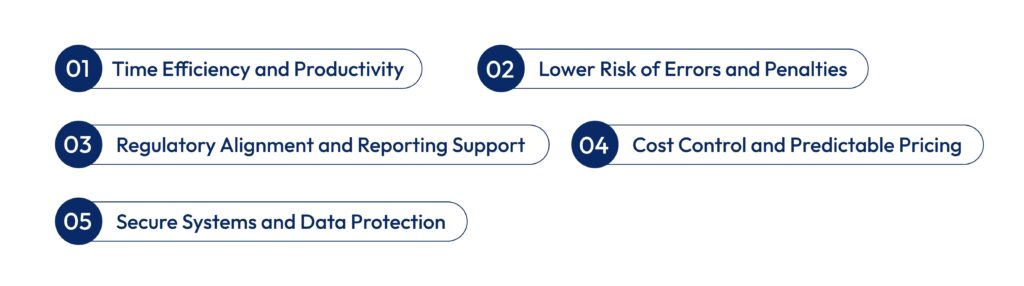
1. Time Efficiency and Productivity
Outsourcing payroll removes repetitive administrative tasks from internal teams.
Benefits include:
- Faster payroll cycles
- Reduced data reconciliation
- Less dependency on individual staff members
This allows managers to focus on operations, client management and business development.
2. Lower Risk of Errors and Penalties
Professional payroll outsourcing providers apply standardised procedures and audit trails.
This helps businesses:
- Reduce underpayment risks
- Maintain accurate employee records
- Avoid correction costs
For many SMEs, error reduction alone justifies outsourcing payroll management.
3. Regulatory Alignment and Reporting Support
Australian payroll regulations evolve regularly. Keeping internal staff updated requires continuous training.
Outsourcing payroll solutions include regulatory monitoring and system updates. Providers manage reporting obligations and documentation in line with current requirements, reducing compliance uncertainty.
4. Cost Control and Predictable Pricing
In-house payroll requires software licences, training, backups and specialist staff.
Outsourcing payroll cost structures are usually predictable and scalable. Businesses pay according to employee numbers and service scope, converting fixed expenses into manageable operational costs.
5. Secure Systems and Data Protection
Payroll data contains sensitive personal and financial information.
Outsourced payroll providers use encrypted platforms, restricted access controls, and secure backups. For many SMEs, this level of security exceeds internal capabilities.
Comparing In-House Payroll vs Outsourcing
Choosing between internal management and payroll processing outsourcing firms depends on scale, complexity, and risk tolerance.
The table below outlines common differences.
| Area | In-House Payroll | Outsourced Payroll |
|---|---|---|
| Staffing | Internal payroll officer | External specialists |
| Software | Purchased and maintained | Included in service |
| Compliance Updates | Manual tracking | Provider-managed |
| Error Risk | Higher | Lower |
| Scalability | Limited | Flexible |
This comparison highlights why many payroll outsourcing small business users prefer external providers.
Understanding the Payroll Outsourcing Process
Understanding the operational process helps businesses evaluate payroll outsourcing service providers.
Most professional payroll outsourcing models follow these steps:
- Employee and contract data setup
- Secure submission of timesheets and adjustments
- Automated payroll calculation
- Review and approval stage
- Payment and reporting
- Record storage and audit support
This structured approach improves consistency and accountability.
For growing companies seeking regional support, services such as payroll outsourcing Brisbane provide location-specific compliance knowledge alongside national systems.
Choosing Reliable Payroll Outsourcing Companies
Not all outsourcing payroll companies deliver the same standards. Careful evaluation is essential.
When reviewing outsourced payroll providers, consider:
- Industry experience
- Data security certifications
- Service-level agreements
- System integration capability
- Client support structure
For accounting practices, outsourcing payroll services for small businesses and accountants should also support multi-client reporting and integration with practice software.
Supporting Growth Through Outsourced Payroll Solutions
Scalability is one of the strongest outsourcing payroll advantages.
As staff numbers increase, payroll complexity rises. Multiple locations, varied awards and changing work patterns require adaptable systems.
Outsourced payroll providers Australia-based SMEs use typically offer:
- Multi-location support
- Flexible employee onboarding
- Real-time reporting
- Expansion-ready platforms
This allows businesses to grow without rebuilding internal processes.
Integrating Payroll with Bookkeeping and HR Functions
Many SMEs combine payroll with wider financial management.
Outsource bookkeeping and payroll arrangements create unified reporting and data consistency. This reduces reconciliation issues and improves financial visibility.
Some providers also support benefits of outsourcing payroll and HRM functions include coordinated leave management, employee records and workforce reporting.
Conclusion
Outsourcing payroll offers clear operational, financial and compliance benefits for Australian SMEs. By reducing administrative pressure, improving accuracy and strengthening regulatory alignment, payroll outsourcing services help businesses maintain stability and plan confidently.
This article has explained how payroll outsourcing benefits translate into time savings, lower risk, predictable costs and scalable systems. It has also compared in-house payroll vs outsourcing and outlined practical selection criteria.
Ready to streamline your payroll? When implemented correctly, outsourcing payroll becomes a reliable foundation for sustainable business operations.
Speak to our Outbooks Australia team at info@outbooks.com.au or 0451 320 102 to understand how our payroll outsourcing services work for your business.
Frequently Asked Questions

Parul is a content specialist with expertise in accounting industry. Her writing covers a wide range of domains such as, Accounts Payable, Accounts Receivables, Bookkeeping and more. She writes well-researched content and has a strong understanding of accounting terms and industry-specific terminologies. As a subject matter expert, she simplifies complex concepts into clear, practical insights, helping businesses with accurate tips and solutions to make informed decisions.