
A white-label partner producing work under your firm’s brand is only as reliable as its weakest review step. One reconciliation that slips through unchecked, or a report delivered a day late, reaches your client looking like your firm’s mistake, because the client never sees the provider behind it.
That’s the real risk in white-label accounting and bookkeeping. It isn’t outsourcing itself. It’s outsourcing without visibility into how a provider controls the accuracy of the actual bookkeeping and accounting work, secures the data behind it and defines accountability before a problem ever reaches you. Most firms discover the gaps in a provider’s process only after something has already gone wrong, which is the wrong time to find out.
This guide is written for firm owners, practice managers and finance leads evaluating a white-label provider, or auditing one they already use and need a concrete, checkable list covering both quality control of the work and data security around it, not a features page.
Key takeaways
- Quality control and data security are separate things to verify, strength in one doesn’t guarantee strength in the other.
- Ask for compliance frameworks by name, general assurances like “we take security seriously” aren’t the same as a documented policy.
- Each engagement model places review responsibility for the accounting work in a different place, confirm which applies to you.
- Cross-border data access is standard in outsourcing, but it must be disclosed and contractually controlled.
- Client relationships, pricing and commercial judgement should stay with your firm regardless of what’s outsourced.
What Quality Control should actually mean in an agreement?
The phrase gets used loosely across the industry and that inconsistency is exactly where risk hides. Quality control in white-label accounting services should be treated as a defined operational standard, not a general claim.
A reliable provider should be able to demonstrate a documented review process that explains how work is reviewed, corrected and approved before it reaches your firm.
The core elements of that process are outlined below.
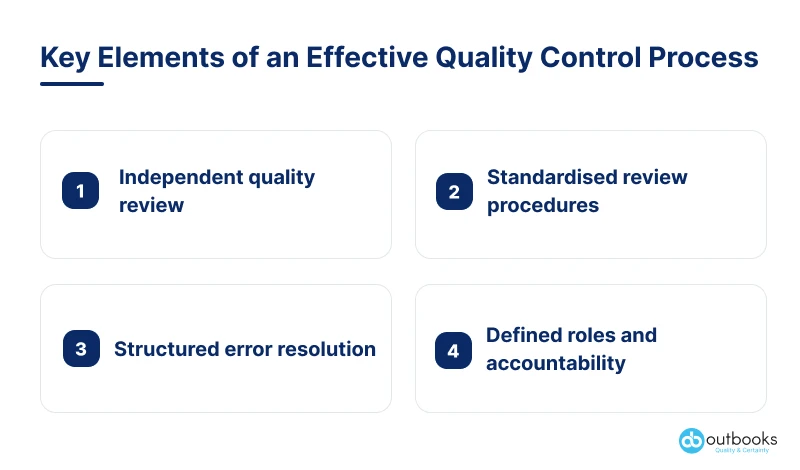
Each of these plays a different role in the process:
- Independent quality review: The reviewer is a different person from the preparer, not a self-check on the same file.
- Standardised review procedures: Every file is verified against a fixed checklist, not reviewed ad-hoc based on whoever’s available.
- Structured error resolution: A defined process exists for catching an error, correcting it and re-verifying the file before delivery.
- Defined roles and accountability: It’s clear who prepared the file, who reviewed it and who signed off before it reached you.
Together, these are what separate an actual review process from a provider simply saying they review their work. When evaluating a provider, check who reviews the work, what standards they follow, and how errors are resolved before delivery.
If a provider tells you they run “an internal review before delivery,” ask who performs that review, whether it’s the same person who prepared the file or a separate reviewer, and what checklist or standard they are reviewing against. That answer is what separates a provider your firm can rely on from one that only sounds reassuring.
- A provider that can answer specifically is operating a process.
- A provider that repeats “we’re committed to quality” is describing an intention, not a control you can rely on.
How the Engagement Model affects accountability for the work itself?
Quality control isn’t only about the provider’s internal checklist, it’s also structural, because the engagement model you sign determines who is actually responsible for catching an error before it reaches your client and how quickly it gets corrected.
Providers also commonly offer different engagement structures depending on whether you’re an accounting firm or a business, so the comparison isn’t always apples to apples.
| Engagement model | Typically offered to | Where review responsibility for the accounting work sits |
|---|---|---|
| Staff Augmentation | Both accounting firms and businesses | The assigned resource works inside your systems, so your firm typically retains final sign-off before figures go to the client. |
| Pay-As-You-Go (hourly) | Accounting firms | Suits variable workloads. Confirm whether hours spent fixing a coding error or a reconciliation that doesn’t tie out are billable to you or absorbed by the provider. |
| Managed Service | Accounting firms | The provider owns more of the production and internal review before anything reaches you. Their internal QA becomes the primary safeguard on accuracy. |
| Fixed Fee Per Month | Businesses | Set monthly fee for an agreed scope. Confirm what happens if actual workload and the review time it needs, exceeds the agreed scope. |
Each structure places accountability differently and it should be written into the agreement rather than assumed.
- Under Staff Augmentation, since your firm keeps final sign-off, ask for a documented right to replace the assigned resource if reconciliation accuracy or turnaround consistently falls short, without losing the remainder of the term.
- Under PAYG, get the treatment of correction time stated explicitly. This is the detail firms most often assume is “obviously not billable” and then find out otherwise mid-engagement.
- Under Managed Service or Fixed Fee, since the provider’s internal review is doing most of the checking before you ever see the file, ask specifically what that review step catches (coding errors, unreconciled accounts, missed reclassifications) and what recourse exists if an error still reaches your client despite it.
Compliance frameworks to verify
Data security is a separate, equally important thread to quality control, not a substitute for it. For an Australian engagement, three frameworks are relevant:
| Framework | What it covers | What to ask the provider |
|---|---|---|
| Privacy Act 1988 (Cth) and the Australian Privacy Principles | Baseline legal framework for collecting, using and disclosing personal and client information | Do you operate in accordance with these and can you point to your published policy? |
| ACSC Essential Eight | Australian Cyber Security Centre’s baseline for protecting business systems against common cyber threats | Are your controls aligned with the Essential Eight and at what maturity level? |
| ISO/IEC 27001:2022 | International information security management standard | Is your infrastructure independently certified, or only “aligned”? Ask to see the certificate if certification is claimed. |
Key considerations before signing with a white-label provider
Evaluating a provider comes down to two areas: how they control the accuracy of the accounting work itself and how they secure the data behind it. Each area below sets out what to confirm before signing.
1. Accounting quality
Review process: Confirm how a file is checked before it’s marked complete and whether that process is documented rather than described only in general terms.
Accountability under your engagement model: Confirm which engagement model applies to your firm or business specifically and how correction responsibilities are handled under that structure.
2. Data security
Data location: Confirm where your data is stored and whether it’s hosted within Australia or overseas.
Overseas access: Confirm whether staff outside Australia will access client data as part of the engagement and if so, what contractual and technical controls apply.
Access controls: Confirm what multi-factor authentication and role-based access controls are in place and whether access is removed immediately when a staff member’s role changes or their engagement ends.
Breach response: Confirm the documented process if a data breach occurs and whether it aligns with the Notifiable Data Breaches scheme under the Privacy Act 1988 (Cth).
Sub-processors: Confirm whether third-party sub-processors are used and whether they’re contractually bound to the same standards.
Retention and destruction: Confirm the provider’s data retention periods and how data is securely destroyed once no longer required.
What decisions should stay with your firm?
Regardless of what production work is outsourced, client communication, pricing and any commercial judgement call should remain yours. A provider operating correctly stays behind the scenes and escalates anything requiring judgement back to your firm rather than deciding it independently. This is as strong a quality signal as any certification: it shows whether the provider understands where their role ends and yours begins.
How Outbooks can help?
White-label accounting and bookkeeping is one form of outsourcing accounting and bookkeeping support and the same scrutiny that applies to any outsourced provider applies here.
Outbooks publishes its data security and privacy practices as dedicated policy pages rather than only summarising them on request. Its approach is designed to comply with the Privacy Act 1988 (Cth) and the Australian Privacy Principles and is aligned with the ACSC Essential Eight and ISO/IEC 27001:2022. Published controls include multi-factor authentication across all system access, role-based access tied to job responsibilities, encrypted data transfers and Australia-based servers accessed through secure VPN connections.
Engagement structures also differ by client type: accounting firms can choose between Staff Augmentation, Pay-As-You-Go and Managed Service, while businesses can choose between Staff Augmentation and Fixed Fee Per Month. Under the Managed Service model specifically, all client communication stays with the firm, with Outbooks operating purely as a back-office team and no direct contact with end clients.
Conclusion
Choosing a white-label accounting provider is about more than adding capacity. It’s about protecting your firm’s reputation, maintaining consistent quality, and ensuring client work is delivered through secure, well-defined processes.
Before making a decision, look beyond service lists and pricing. Evaluate how quality is reviewed, how data is protected, how communication is managed, and where accountability sits throughout the engagement. These are the factors that determine whether a white-label partnership will support your firm’s long-term growth.
To learn more about Outbooks white-label accounting and bookkeeping services, book a consultation now or email us at info@outbooks.com.au.
FAQs
What should any firm check about a provider’s quality control before signing?
Ask them to name their review process step by step, request their compliance certifications in writing and confirm data handling policies directly. If answers stay general rather than specific, the process likely isn’t formalised.
If a white-label provider makes an error that reaches our client, who is actually liable?
Liability should be defined in the signed service agreement, not assumed. Confirm in writing how correction costs and rework are handled and whether responsibility changes depending on which engagement model you’ve chosen.
Do accounting firms and businesses get access to the same white-label engagement models?
Not always, providers often offer accounting firms more structures, such as staff augmentation, hourly and managed service, while businesses get a narrower set, typically staff augmentation and fixed fee. Confirm which applies to you.
Is it a red flag if a white-label provider’s staff are based outside Australia?
No, this is standard in outsourcing. It becomes a concern only if it’s undisclosed or uncontrolled. Confirm contractual confidentiality obligations, access restrictions and compliance with the Australian Privacy Principles for cross-border data handling.
What should be in a white-label provider’s documented data breach response plan?
A process covering assessment, containment, remediation and notification to affected individuals, aligned with the Notifiable Data Breaches scheme under the Privacy Act 1988 (Cth). Ask to see the document, not just a description of it.