For a growing Australian SME, clean payroll processing helps keep employee pay accurate, records organised and payroll issues easier to identify before they become correction work. As payroll volume increases, repeated mistakes can also make each pay cycle harder to manage.
This article explains what clean payroll processing involves, why payroll becomes harder to manage as a business grows, which checks can reduce errors and when outsourcing payroll processing may make sense.
Key takeaways
- Clean payroll processing means accurate data, consistent steps, defined review checks and organised records.
- A structured payroll process reduces errors and keeps payroll manageable as changes increase.
- Payroll complexity depends on the volume of payroll changes, not just employee numbers.
- Without review checks, errors may be detected only after payroll is processed.
- Payroll outsourcing can often work with existing systems such as Xero, MYOB or Sage.
- The right payroll provider should fit the business’s existing workflow.
How Clean Payroll Processing benefits a Growing Australian Business?
The main benefit is catching payroll issues before they become employee queries or post-payday corrections. A useful process gives the person handling payroll specific points to check before each pay run is approved.
These checks matter at different stages of the payroll cycle, particularly when changes need to be picked up, reviewed and corrected before they affect an employee’s pay.
Preventing payroll errors
A payroll check should compare the changes received for the current pay period with the payroll being prepared. This can catch an entry that has been missed, entered incorrectly or carried over from the previous cycle.
For example, an employee has an approved change from $30 to $33 per hour, effective from the current fortnight. They work 80 hours during that period. If the old rate is still used, payroll will show $2,400 instead of $2,640. Checking the approved change against the payroll before approval would flag the $240 difference while it can still be corrected in the same pay run.
Reducing correction work
Finding an error before payroll is finalised is usually simpler than correcting it after employees have been paid. Once a pay run is complete, the original instruction, payroll entry and amount paid may all need to be checked before the correction can be made.
For example, three casual employees submit different hours for the same fortnight. One timesheet shows 26 hours, but 20 hours are entered into payroll. If the difference is picked up during the review, the timesheet can be checked and the payroll updated before approval. If it is found after payday, the same issue requires an additional check and correction outside the normal pay run.
Managing frequent pay cycles
Payroll workload also depends on how often employees are paid. ABS data shows that 53% of employees were paid fortnightly and 33% weekly in the week ending 15 March 2024.
For businesses running weekly or fortnightly payroll, changes need to be captured and checked repeatedly rather than only at month-end.
For instance, a business running fortnightly payroll receives a new starter’s details, two leave requests and several changes to hours during the same period. Each item needs to be captured before the payroll cut-off. A defined process gives the person processing payroll a consistent way to check that each change has been received and included.
Keeping payroll records usable
Payroll records need to remain easy to check after the pay run. If an employee questions a payment several weeks later, the business should be able to identify the information used to prepare that payment without reconstructing the entire pay cycle.
Fair Work requires employers to keep employment records for 7 years, including records relating to pay, hours worked, leave and termination.
For example, an employee queries why their pay was different in a particular fortnight. If the payroll record reflects the hours submitted and the approved change for that period, the business can check the entry against the original information and explain the difference without searching through unrelated records.
Keeping the process consistent as payroll changes increase
Employee numbers alone do not determine payroll workload. A business with 15 employees can have a more complicated pay cycle than a larger business if several employees have different hours or changes at the same time.
Consider a business where most employees have consistent hours but three casual employees submit different hours each fortnight. Adding more employees with variable hours increases the number of inputs that need to be checked, even when the overall payroll remains relatively small.
These benefits depend on having the right checks in place. As payroll becomes more involved, a simple process may no longer be enough to make sure every change is captured and reviewed before approval.
Why Payroll Processing needs more control as an Australian SME grows?
Payroll does not become difficult simply because a business reaches a particular headcount. The workload increases when there are more employees and more changes to process during each pay cycle.
- More employees to check: Each employee adds another set of payroll information to maintain. As the workforce grows, checking every pay line manually becomes harder to manage without a defined process.
- More employee changes: Growing businesses may have more new starters, exits, pay-rate changes and other payroll instructions to process. Each change needs to reach the person responsible for payroll and be applied correctly.
- More pressure on manual checks: A manual check that works for a small team can become difficult to maintain when payroll contains dozens of employees and multiple changes each cycle. Without a defined review step, checks can become rushed or inconsistent.
- Greater reliance on individual knowledge: If one person knows how the payroll is processed and there is no documented backup, their absence can create a problem for the next pay run. This can be particularly relevant for small Australian businesses and accounting firms managing payroll for multiple clients.
For example, consider a 20-employee Australian business with one fortnightly pay run. During the same pay period, two employees take leave, three casual employees work different hours than usual, one employee receives an approved pay-rate change and a new employee starts.
The payroll workload has increased even though the business still has only 20 employees. Each change needs to be received, checked and applied correctly before the pay run is approved. If one change is missed, the issue may only become visible when the employee checks their payslip.
This is why payroll complexity is better measured by the number and type of changes being processed each cycle, rather than employee numbers alone.
Payroll processing: A step-by-step process
For an Australian SME, a controlled pay cycle should follow defined stages. The exact checks can vary by business, but the main process should remain consistent.
A consistent payroll process gives the team a clear sequence to follow, from receiving employee changes through to final approval and record-keeping. The main stages are shown below.
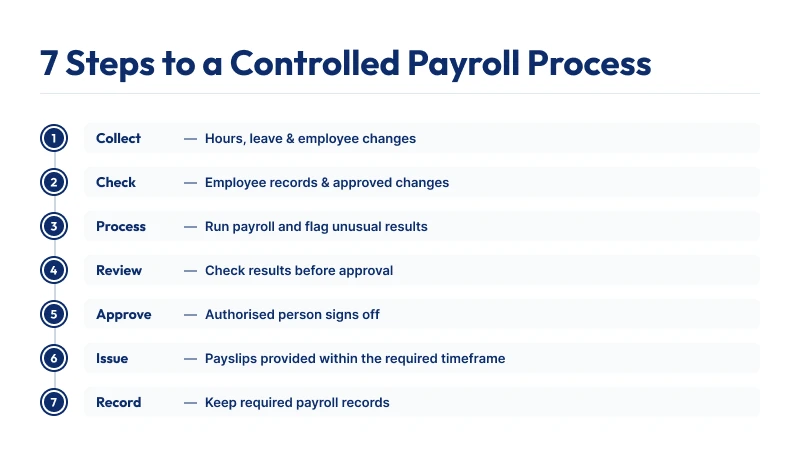
Each stage builds on the one before it, so an error in the initial payroll information can carry through the process. This is why checking the completed pay run before approval is an important control.
What happens when payroll processing lacks proper controls?
When payroll has no defined review process, errors can remain unnoticed until after employees have been paid.
For example, if an approved change to an employee’s pay rate is received but not updated before the pay run, the incorrect rate may be applied to that period. Once the employee raises the discrepancy, the business may need to check the original instruction, review the payroll record, identify where the change was missed and process the required correction.
A review before approval gives the business an opportunity to identify this type of issue before it reaches the employee.
What controls should Payroll Processing have?
The right controls depend on payroll volume, the number of changes processed each cycle and how responsibilities are divided within the business.
For a business outsourcing payroll, the key questions are who reviews the work, how instructions are handled, who can access payroll data and who has final approval.
- Payroll cut-off: Set a clear deadline for submitting hours, leave, new starters, exits and other payroll changes. This gives the payroll team enough time to apply the changes and complete the review before approval.
- Defined review and approval: A pay run should have a clear review stage before approval. The person responsible for final approval should also be identified.
- Correction handling: The process should explain what happens when an error is found. The original instruction and payroll record should be checked, the discrepancy identified and the correction recorded.
- Clear communication: Payroll instructions should have a defined route into the processing team, and employee queries should have a clear point of contact. Questions that require a client or management decision should be referred back rather than being changed without approval.
- Secure access to payroll data: Payroll contains sensitive employee information, so access should be limited to people who need it for their role. Businesses should also understand how a provider manages user permissions and access to client payroll data.
These controls are especially important when payroll processing is outsourced. The business should know what the provider handles, what remains with the firm and how issues are reported. This keeps processing responsibilities clear without changing who approves payments or makes client decisions.
When does Outsourcing Payroll Services make sense?
Payroll outsourcing may make sense when recurring payroll work is taking more internal time than the business can comfortably manage. It can also be useful when payroll knowledge sits with one person, processing volume is increasing or the existing team needs additional capacity.
Common signs include:
- Payroll takes increasing amounts of internal time each pay cycle.
- Manual checking becomes difficult to maintain as payroll volume increases.
- Payroll knowledge sits with one person and there is no clear backup.
- The business has added employees or locations and payroll now takes significantly more time to process each cycle.
- Payroll corrections and rework are becoming more common.
- The team is spending time on recurring payroll administration that could be handled by an external processing team.
- The firm wants to increase payroll capacity without adding the same level of internal processing workload.
What should Australian businesses look for in a payroll processing provider?
Price is only one part of the decision. The provider’s process should also fit the way payroll is already managed.
| What to check | Why it matters |
|---|---|
| Payroll cut-off | Defines when payroll changes need to reach the processing team |
| Review process | Helps identify errors before the pay run is approved |
| Approval structure | Keeps final approval with the authorised person |
| Correction handling | Provides a defined process for investigating discrepancies |
| Communication process | Reduces the risk of payroll instructions being missed |
| Data access | Helps control who can access sensitive employee information |
| Software compatibility | Allows the provider to work within the existing payroll setup where supported |
| Reporting | Gives the business visibility over each pay run |
| Capacity | Helps support increasing payroll volume |
How Outbooks supports Payroll Processing in Australia?
Outbooks provides payroll processing support for Australian businesses. The service can include payroll preparation, payment management, and employee changes such as new starters, terminations and pay-rate updates.
Outbooks can work within existing payroll platforms, including Xero, MYOB and Sage, subject to the agreed setup and access permissions. Employee queries can be handled through a dedicated mailbox, while matters requiring a management decision can be referred back to the client.
The business retains its approval responsibilities, while Outbooks handles the agreed processing work and reviews payroll discrepancies against the relevant records before corrections are processed.
If clean payroll processing is taking more time than your team can manage, book a consultation with Outbooks or email info@outbooks.com.au.
FAQs
What should be checked before approving a payroll run?
Check employee changes, hours, leave, pay-rate updates, new starters, exits and unusual differences against the information received for the pay period. The completed pay run should be reviewed before final approval.
Does outsourcing payroll change how or when employees get paid?
Not necessarily, the existing pay cycle and payment arrangements can remain in place where this matches the agreed workflow. The outsourced provider handles the processing tasks assigned to them.
Can a payroll error be corrected after a pay run is finalised?
Yes, the relevant payroll records and original instructions can be reviewed to identify the discrepancy before the required correction is processed and recorded.
Do businesses need to send payroll instructions every cycle?
This depends on the agreed workflow. Usually, recurring payroll information continues from the existing setup, while changes such as new starters, exits or pay-rate updates need to be provided for processing.
What happens if the person responsible for payroll leaves?
A documented process and outsourced support can reduce reliance on one person’s payroll knowledge. The provider can continue handling the agreed processing work while the business retains appropriate approval responsibilities.
Does an Australian business need to change its payroll software when outsourcing?
Not necessarily, a provider may be able to work within the existing payroll system, depending on the software, permissions and agreed workflow.
How much lead time is needed to start outsourcing payroll processing?
The timing depends on the business and payroll setup. Onboarding generally involves reviewing the current process, confirming payroll data and software access and agreeing on communication and approval responsibilities before processing begins.