




When a business sells on credit, the money from that sale does not exist until the customer pays. Until then, it is a number on a ledger and a promise. How quickly and consistently that promise is fulfilled determines whether the business has the cash it needs to operate, grow and plan ahead.
Most payment problems are not surprises. They show up in the data before they become a crisis. The businesses that catch them early are the ones running the right accounts receivable reports regularly and acting on what those reports show.
For Australian SMEs and accounting firms managing collections without a dedicated AR team, this is not about adding complexity. It is about having the right information at the right time so that decisions about credit, collections and cash flow are based on facts rather than assumptions.
Key takeaways
- Accounts receivable reports show which customers owe money, how long they have owed it and what that means for cash flow.
- The AR aging report is the most used report for identifying overdue balances and prioritising collections.
- Days Sales Outstanding measures how long a business takes to collect payment after a sale and is the single most important AR metric.
- Running AR reports on a consistent schedule separates businesses that manage cash flow proactively from those that react after problems occur.
- Outsourcing accounts receivable gives Australian businesses structured AR reporting and consistent collections follow-up without building the function internally.
What is Included in the Accounts Receivable Report?
Accounts receivable reporting is the regular practice of generating and reviewing financial reports that show what customers owe, how long they have owed it and how effectively the business is collecting what it is due.
It covers more than just unpaid invoices. When managed effectively, accounts receivable provides businesses with clear visibility into:
- Which customers are approaching or exceeding their credit limits
- Which invoices are at risk of becoming bad debts
- How collection performance has changed over time
- Where disputes are holding up payments
- What cash is realistically expected to come in and when
A balance sheet shows the total AR balance. These reports explain what is behind that number and what needs to happen next.
The 8 reports below cover three distinct areas of AR management services. Knowing what each one does is where good accounts receivable reporting begins.
Accounts Receivables Reports Australian Businesses should understand
Every accounts receivable report serves a different purpose. Some help identify overdue invoices, others measure collection performance, assess customer credit risk or forecast future cash inflows.
Together, they provide a complete view of the receivables function, enabling businesses to make informed decisions, prioritise collections and maintain healthier cash flow. The reports below are among the most commonly used by Australian businesses to monitor and improve accounts receivable performance.
| Purpose | Report | What the Report shows | Review Frequency |
|---|---|---|---|
| Monitoring What is Owed and by Whom | AR Aging Report | Outstanding invoices grouped by overdue period | Weekly or fortnightly |
| Receivables by Customer Report | Outstanding balances and payment history by customer | Monthly | |
| Accounts Receivable Analysis Report | Trends in collection performance and overdue receivables | Quarterly | |
| Managing Cash and Payments | Cash Flow Forecasting Report | Expected cash inflows from outstanding receivables | Monthly |
| Payment Report | Payments received and their allocation against invoices | Weekly | |
| Cash Reconciliation Report | Reconciliation of the AR ledger with bank receipts | Monthly | |
| Managing Risk, Disputes and Collection Performance | Customer Credit Report | Customer credit exposure and payment behaviour | Quarterly |
| AR Dispute Resolution Report | Open invoice disputes and their resolution status | Weekly | |
| Days Sales Outstanding (DSO) | Average time taken to collect customer payments | Monthly |
While each report serves a specific purpose, they work best when viewed as part of a broader accounts receivable reporting framework.
The illustration below groups the key reports by their primary objective, making it easier to see how they support collections, cash flow management and credit risk monitoring.
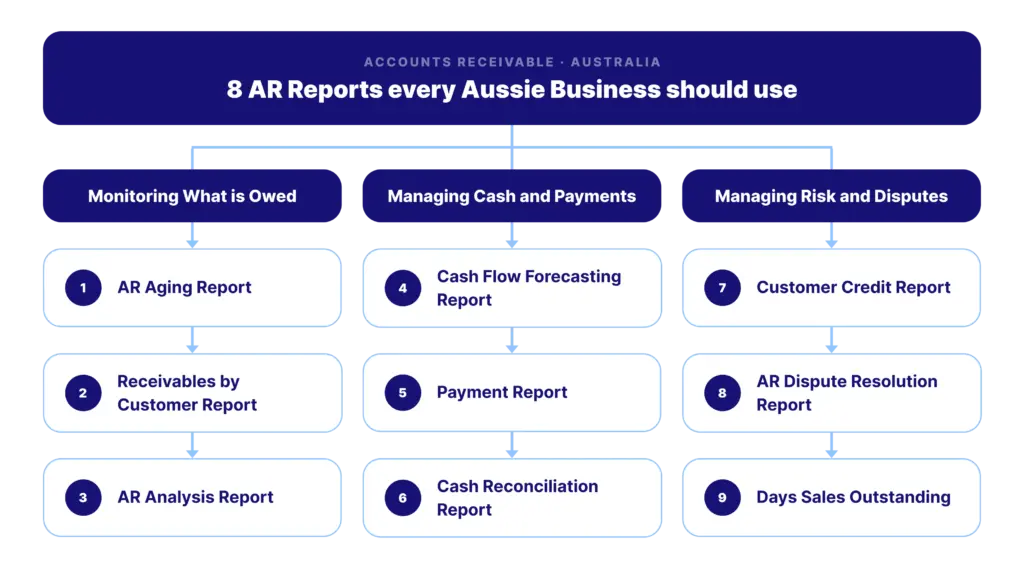
The following sections explore each reporting group in more detail, explaining the purpose of every report, the insights it provides and how businesses can use it to strengthen their accounts receivable process.
Monitoring What is Owed and by Whom
Before a business can improve its collections, it needs to know exactly what it is owed, who owes it and how long those balances have been unpaid. The three reports in this group answer those questions from different angles.
AR Aging Report
The AR aging report groups all unpaid invoices by how long they have been unpaid, typically in 30-day increments. It is the starting point for any collections conversation because it immediately shows where the risk is concentrated.
Formula: Days Overdue = Current Date minus Invoice Due Date
| Aging Bracket | Risk Level | Action |
|---|---|---|
| Current | Low | Monitor |
| 1 to 30 days overdue | Low to moderate | Send reminder |
| 31 to 60 days overdue | Moderate | Follow-up call |
| 61 to 90 days overdue | High | Direct contact |
| 90+ days overdue | Very high | Collection decision |
A business reviewing this report weekly can act on a 45-day invoice before it reaches 90 days. One that reviews it monthly may only notice the balance when recovery options are already limited.
Receivables by Customer Report
This report groups unpaid balances by customer rather than by age. It shows total balance per customer, payment terms, credit limit utilisation and a record of on-time versus late payments.
Formula: Customer Concentration = (Customer Balance / Total AR) x 100
Two customers can carry the same balance and represent very different levels of risk. One may have never paid late. The other may have missed payment terms on four of the last six invoices. The balance sheet treats them identically. This report does not.
For Australian accounting firms managing outsourced accounts receivable for clients, this is one of the most frequently used tools in day-to-day AR management.
Accounts Receivable Analysis Report
The AR analysis report measures how effectively the business is converting credit sales into collected cash and examines whether collection performance is improving or declining over time.
Formula: Collection Effectiveness = (Cash Collected / Total Amount Due) x 100
It identifies customers who are consistently late across multiple periods, whether late payments correspond to specific invoice types and how the overall proportion of current versus overdue balances has shifted. Running this quarterly allows a business to catch a deteriorating customer relationship before it becomes a bad debt.
Managing Cash and Payments
Knowing what is owed is only part of accounts receivable reporting. A business also needs to know when money is likely to come in, confirm payments have been correctly recorded and reconcile what the AR system shows against what is actually in the bank.
Cash Flow Forecasting Report
This report uses AR data to project when unpaid invoices are expected to be collected based on current balances and historical payment behaviour.
Formula: Projected Cash Inflow = Unpaid Balance x Historical Collection Rate for That Aging Bracket
A services business that invoices on 30-day terms but whose customers consistently pay in 45 to 50 days will regularly find itself short if it plans around stated terms rather than actual behaviour. The cash flow forecasting report closes that gap and gives a business three months of forward visibility into its collections position.
Payment Report
The payment report records all payments received over a given period, showing payment dates, amounts, invoice references and payment methods.
It reveals actual customer payment behaviour over time and confirms that every payment has been correctly applied to the right invoice. No formula applies here, this is a record-based report and its value lies in completeness and accuracy.
Cash Reconciliation Report
The cash reconciliation report confirms that what the AR system shows as collected matches what has actually been received in the bank.
Formula: Reconciled Balance = Opening AR Balance + Invoices Raised minus Payments Received minus Credits Issued
Any difference between the AR ledger and the bank needs an explanation. Common reconciling items include payments not yet recorded, credits not yet applied and bank fees that have reduced the net amount received.
For businesses running accounts receivable reporting across multiple customers and payment methods, this report keeps the AR ledger accurate and audit-ready.
Managing Risk, Disputes and Collection Performance
The final group focuses on the factors that determine whether unpaid balances become problems: customer credit risk, unresolved disputes and the overall speed of collections.
Customer Credit Report
The customer credit report assesses each customer’s creditworthiness based on payment history, current balance and credit limit utilisation.
Formula: Credit Utilisation Rate = (Current Balance / Credit Limit) x 100
A customer whose utilisation rate has been climbing over six months while payment timeliness has been declining is showing a pattern that warrants action before the balance becomes unrecoverable.
This report informs decisions about whether to increase a credit limit, reduce it, require upfront payment or stop extending credit entirely.
AR Dispute Resolution Report
The dispute resolution report tracks all invoice disputes raised by customers, including the nature of the dispute, its current status and its impact on unpaid balances.
Formula: Dispute Rate = (Total Disputed Invoices / Total Invoices Raised) x 100
When the same dispute reason appears repeatedly across multiple customers, the problem is not the customers.
It is a process issue upstream that AR reporting is making visible. Resolving disputes quickly is one of the most direct ways to reduce Days Sales Outstanding.
Days Sales Outstanding
DSO measures the average number of days a business takes to collect payment after a sale.
Formula: DSO = (Total Accounts Receivable / Total Credit Sales) x Number of Days
A rising DSO signals slowing collections and potential cash flow pressure even when revenue looks healthy.
A business offering 30-day payment terms with a DSO of 52 days has a meaningful collections gap that the AR aging report will help explain.
What Outsourcing Accounts Receivable Management looks like?
For Australian businesses without a dedicated AR team, producing and acting on these reports consistently is difficult. Invoices accumulate, reports get produced late and by the time the aging report is reviewed, balances have already become much harder to collect.
Outsourcing accounts receivable management transfers this responsibility to a specialist team that produces reports on schedule, monitors customer payment behaviour and manages disputes with a defined process.
What outsourced accounts receivable services typically cover:
- AR aging reports, customer balance reports and cash flow forecasts produced on a consistent schedule
- Systematic collections follow-up based on aging brackets with escalation rules for non-responsive accounts
- Open disputes tracked, assigned and resolved within defined timeframes
- Payment reports and cash reconciliation completed regularly to keep the AR ledger accurate
- A clear summary of the AR position delivered to the business without requiring internal analysis
For Australian SMEs and accounting firms that want consistent accounts receivable reporting without the overhead of managing it themselves, this model provides the structure that most businesses struggle to maintain in-house.
Your Trusted Outsourced Accounting Partner.
Get Started TodayConclusion
Accounts receivable reports are not administrative outputs. They are the tools that show whether cash flow is healthy, which customers present risk and where collections effort needs to be directed. Running them consistently and acting on what they show is what separates businesses that manage AR well from those that manage it reactively.
For Australian businesses managing this without a dedicated AR function, the challenge is not understanding what the reports show. It is finding the time and structure to produce them consistently and follow through on what they reveal.
Outbooks provides outsourced accounts receivable services to Australian businesses and accounting firms that need structured AR reporting, consistent collections follow-up and accurate reconciliation without managing it internally. To find out how we can help, email info@outbooks.com.au or call 0451 320 102.
Frequently Asked Questions

Parul is a content specialist with expertise in accounting industry. Her writing covers a wide range of domains such as, Accounts Payable, Accounts Receivables, Bookkeeping and more. She writes well-researched content and has a strong understanding of accounting terms and industry-specific terminologies. As a subject matter expert, she simplifies complex concepts into clear, practical insights, helping businesses with accurate tips and solutions to make informed decisions.