

When debtor days start increasing month on month, it is usually not down to one bad customer. It is a gap somewhere in how credit gets approved, how invoices go out or how overdue accounts get followed up. Longer payment times leave more cash tied up in unpaid invoices, reducing the cash available for payroll, supplier payments and other regular expenses.
Credit control sets clear rules for approving credit, agreeing payment terms and following up overdue invoices. When these controls are applied consistently, debtor days are easier to keep under control.
This piece is for Australian businesses watching debtor days rise, not just finance teams, who want a credit control approach that that keeps debtor days under control. It looks at what a credit control policy should include, what an effective process looks like day to day and how to monitor accounts receivable so the same problems do not keep resurfacing.
Key takeaways
- A defined credit control policy helps keep debtor days under control, although applying it too rigidly can limit sales opportunities.
- Credit limits should reflect customer payment behaviour and the amount of exposure the business can reasonably carry.
- Choosing between a restrictive, moderate or liberal credit policy shapes how quickly outstanding balances are collected and how much sales risk the business is willing to carry.
- A consistent credit control process, reviewed weekly, catches deteriorating payment behaviour earlier than a monthly review.
- Credit control works best when policy, process and monitoring are treated as one system rather than separate tasks.
Why is Credit Control important when Debtor Days are rising?
Debtor days increase when the gap between a credit sale and the payment landing in the bank keeps stretching. Often this starts small. A customer pays five or ten days later than usual and if nobody notices, the same customer keeps paying later each month.
Credit control is important because it puts structure around that gap. It decides who gets credit, how much, on what terms and what happens the moment a payment is late. Without it, most businesses end up handling overdue invoices one by one as they come in, rather than following a consistent approach.
Much of this comes down to decisions made before a sale is even agreed, not just how overdue accounts get chased afterward.
What Credit Control Strategies can reduce Debtor Days?
The most effective credit control strategies address customer exposure before the sale and payment behaviour after the invoice is issued. Payment terms, customer assessment, credit limits, invoicing accuracy and payment incentives each influence how much money can become outstanding and how quickly it should be collected.
Clear payment terms, customer credit checks, defined credit limits, accurate invoicing and early payment incentives can help control how much money remains outstanding from each customer.
The main controls fall into five areas, covering how credit is agreed, how customer exposure is assessed and how quickly invoices move towards payment.
1. Set payment terms that support faster collection
Payment terms should be clear, agreed in advance and practical for the type of customer and transaction. They should state when payment is expected, accepted payment methods and what happens if an invoice remains unpaid.
Terms also need to be tested against actual payment behaviour. For example, if customers on 30-day terms are routinely paying closer to 45, the business needs to work out whether the issue is poor follow-up, delays in the customer’s own approval process or terms that no longer match the commercial relationship.
A specific due date also gives the business a firm point for reminders and ageing. Payment terms set when an invoice should be paid, while the credit limit determines how much unpaid exposure the business is willing to carry.
2. Assess customer risk before extending credit
Credit checks are most useful before exposure is created. The depth of the check should reflect the amount at risk rather than applying the same process to every customer.
For instance, a small retailer opening a modest trade account might only need its ABN checked and a quick look at payment history, while a larger account carrying a much bigger balance could warrant a full credit report and trade references.
The decision should also be revisited when payment behaviour changes. A customer that consistently paid within agreed terms may need a different credit assessment after several late payments.
3. Set credit limits based on customer exposure
A credit limit should reflect the amount the business is comfortable having outstanding from a customer at one time. There is no single Australian formula that works for every SME.
A more useful approach is to consider the customer’s payment history, typical order value, existing balance and the loss the business could reasonably carry if payment stopped. Consider a customer whose average order has grown from $2,000 to $8,000 over a few months. A credit limit set when the relationship began may no longer match the exposure the business is actually carrying.
Limits should also be reviewed when customer behaviour changes. A customer whose orders have increased substantially or whose payments are becoming slower may need a lower limit or different terms.
4. Get invoicing right before chasing payment
Prompt and accurate invoicing removes delays that have nothing to do with a customer’s willingness to pay. Whether an invoice is missing a required purchase order number or simply sent a few days late, either one can add time to the collection cycle before the customer has done anything wrong.
The invoice should carry everything the customer needs to process payment: the amount due, payment terms and payment method. Where a customer requires a purchase order, supporting document or specific reference, that requirement should be checked before the invoice goes out.
A business that finishes a job but waits several days to raise the invoice adds those days straight onto the collection cycle, before credit control has even started working.
5. Give customers a reason to pay early
A small discount for early payment can improve collection times when reminders alone are not changing payment behaviour. For example, a business might offer a 2% reduction for payment within seven days instead of the usual thirty, giving customers a reason to pay sooner rather than waiting until the due date.
This works best on invoices with healthy margins, where the discount cost is smaller than the benefit of receiving cash sooner. It will not suit every account. Customers who already pay on time do not need the incentive and offering it too broadly can reduce margin without changing behaviour.
These controls only work consistently when the business applies the same rules across customers and accounts. Without a written policy, one team member might offer a discount while another does not or credit limits might get set differently for similar customers. That inconsistency is often where debtor days start to creep back up.
What should a Credit Control Policy include?
A credit control policy is what turns these strategies into one consistent approach across every customer, rather than leaving decisions to whoever happens to be handling an account on a given day.
Businesses generally choose between three broad approaches to credit control:
- A restrictive policy limits credit to customers with stronger payment profiles and keeps outstanding exposure lower.
- A moderate policy allows credit more widely while retaining checks around customer risk and exposure.
- A liberal policy makes credit easier to obtain, which can support sales volume but requires tighter monitoring of outstanding balances.
The right approach usually comes down to profit margins, how competitive the market is and how much cash flow pressure the business can handle if a customer pays late or not at all.
A working credit control policy should also include:
- Standard payment terms and when exceptions are allowed
- How credit checks are carried out and at what exposure level they become mandatory
- How credit limits are set, reviewed and adjusted
- Invoicing standards, including what information must be included before an invoice is sent
- How disputes are separated from straightforward late payment
- Who owns each stage of follow-up as an account ages
The policy should be specific enough that two people handling the same overdue account would follow the same rules and escalation process.
Even with a clear policy, how overdue accounts are followed up day to day can have a direct effect on collection times.
What does the Credit Control Process look like?
Credit control procedures should become firmer as an account ages, but the response should still reflect the customer’s history and the reason for non-payment. Consider two customers who are both 20 days overdue: one has paid on time for three years, the other has been late on the last four invoices. The first likely needs a simple reminder. The second may need a phone call straight away.
A typical credit control process moves through the following steps:
- A reminder shortly before the due date, to catch simple oversights before they become overdue balances.
- A follow-up once the due date passes, referencing the invoice, amount and agreed payment date, asking when payment can be expected.
- A phone call or firmer written reminder if there is no response.
- A letter of demand, dispute resolution or debt collection if payment still does not come through.
Not every overdue invoice should move through these steps in the same way. If the customer disputes the amount, the business needs to identify what is holding up payment and route it to whoever can resolve it. For an undisputed balance, the focus stays on payment. For a genuine dispute, resolving the underlying issue is usually the quickest way back into the normal collection cycle.
This distinction becomes more important as the receivables ledger expands, because older invoices can remain unresolved without a clear owner if disputes and delays are treated the same way.
Individual follow-ups show what is happening on specific accounts. The receivables ledger shows whether those efforts are actually improving debtor days across the business.
How should Accounts Receivable be monitored to keep Debtor Days down?
Monitoring should show more than the total amount owed. The business needs to see where balances are ageing and which customers are changing their payment behaviour.
A weekly or regular review can look at:
- Ageing bands: How much is current, overdue or moving into older categories.
- Repeat late payers: Customers consistently paying beyond agreed terms.
- Credit-limit breaches: Accounts carrying more exposure than approved.
- Unresolved disputes: Invoices that remain unpaid because an issue has not been resolved.
- Collection trend: Whether the average time to collect is going up or down.
A rise in average collection time means more when the ageing report shows several major customers have moved into the 60-day band. That points the business towards specific accounts rather than leaving them with a number to investigate.
The same review can also reveal whether the credit control policy itself needs to change.
Regular monitoring can also expose recurring weaknesses in the credit control process, such as late follow-up, unchecked credit-limit exceptions and unresolved disputes.
What Credit Control mistakes can increase the Debtor Days?
Credit control policies can look effective on paper while producing weak results in practice. The most common problems are usually process failures rather than a lack of rules.
These gaps can be easy to miss when each overdue account is handled separately. The following five mistakes highlight some of the areas that can gradually push debtor days higher:
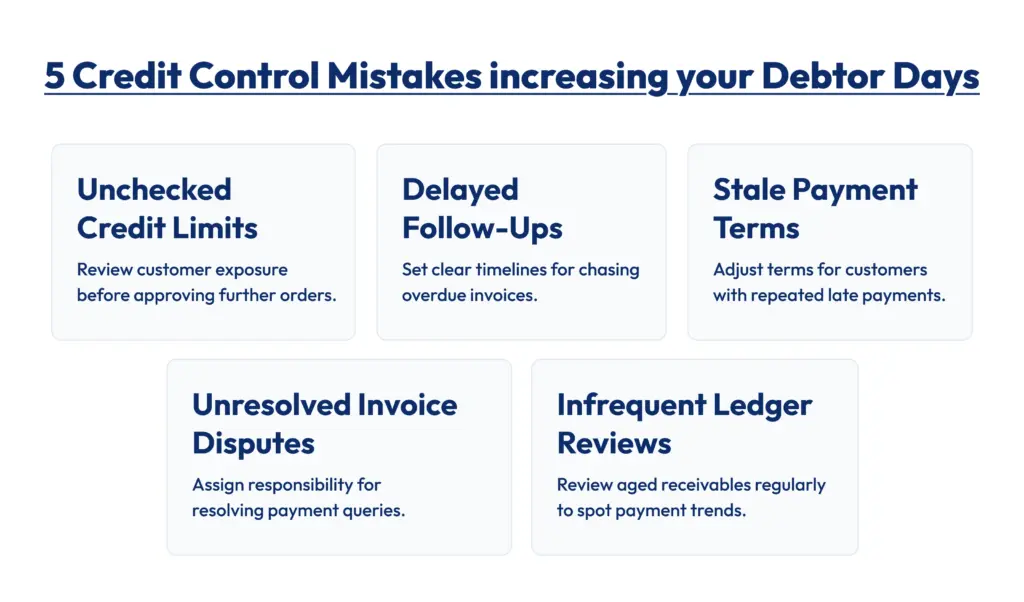
These mistakes can affect debtor days at different points in the receivables cycle, from approving further credit to following up overdue invoices. Reviewing them together can help identify where the existing credit control process is allowing delays or unnecessary exposure to build up.
A practical credit control policy should make responsibility and escalation clear enough that the process continues consistently across the customer base.
Internal payment history is useful for existing customers. For larger prospective customers, the Payment Times Reports Register can provide another indication of how they pay small business suppliers.
Can Australian Businesses check a Customer’s Payment Behaviour?
The Payment Times Reports Register can provide additional information when assessing larger customers. The public register allows users to search payment times reports and compare payment practices across industries and reporting periods. It includes average payment terms and the proportion of payments made within different time ranges.
This information can help a business understand how a prospective customer typically pays its small business suppliers. It should sit alongside the business’s own credit checks and payment history rather than replace them.
Good credit control can reduce debtor days on its own. But policy, process and monitoring all need people to run them consistently and that is often where SME businesses run out of capacity.
When do Businesses need Accounts Receivable Support?
Credit control becomes harder to maintain when a business is handling a growing number of invoices, payment queries, reminders and reconciliations alongside its other day-to-day responsibilities.
At that stage, the problem may be capacity rather than policy. A business can have a sound credit control policy but still see debtor days rise if invoices are not followed up consistently.
How can Accounts Receivable Support help reduce Debtor Days?
As receivables grow, keeping invoices, payment follow-ups and ageing reviews consistent can become difficult to manage internally. This is where external accounts receivable services can help keep the process moving.
Outbooks supports invoice generation, payment tracking, overdue follow-ups, payment matching and reconciliation, credit notes and aged receivable reporting. The team can also review a credit report supplied by the business and flag potential risks, while the final credit decision stays with the business.
For businesses that need regular AR support without adding the full workload internally, this can help keep credit control activities consistent.
Conclusion
Reducing debtor days comes down to how well credit control is run. A clear policy, a defined process and consistent monitoring work together so overdue invoices get caught early instead of piling up.
For businesses that need extra capacity to keep their receivables process consistent, Outbooks can handle the recurring Accounts Receivable work. Book a consultation now or email info@outbooks.com.au to learn more.
FAQs
What is the importance of credit control for a business?
Credit control helps a business manage who receives credit, on what terms and how overdue balances are followed up. Applied consistently, it keeps fewer invoices unpaid for longer periods.
What are the objectives of credit management?
The main objectives are to control customer credit exposure, encourage payment within agreed terms, reduce bad-debt risk and keep receivables at a manageable level.
What are the advantages of credit control?
Consistent credit control protects cash flow, reduces bad-debt risk and gives the business a clear, repeatable way to handle overdue accounts.
What is the difference between credit control and debt collection?
Credit control covers the ongoing process of assessing customers, setting terms, monitoring invoices and following up payments. Debt collection generally refers to recovering a debt after normal credit control efforts have not resolved the overdue balance.
How often should a business review its accounts receivable?
A weekly review can help identify invoices moving into overdue or higher ageing bands before they become larger collection problems. The right frequency depends on invoice volume and customer payment patterns.
Can accounts receivable outsourcing help reduce debtor days?
Yes, consistent invoicing, payment tracking, overdue follow-up and receivables reporting can help reduce delays in the collection process. The effect depends on how the business’s credit control policy is structured.