



Cash flow challenges affect businesses of all sizes, often without warning. Companies with strong sales and healthy profit margins can suddenly find themselves unable to meet payroll or pay suppliers on time. The issue isn’t poor performance it’s the inability to predict and control when cash actually moves through the business.
Recent data reveals that nearly 80% of Australian SMEs experienced cash flow impacts in the past 12 months, according to CommBank’s 2025 survey. More concerning, 43% of Australian SMEs list cash flow as their top business concern, followed by profitability at 38%, according to NAB’s quarterly survey. The gap between reported profitability and available cash creates operational risks that threaten even successful enterprises. Traditional financial accounting provides historical data, but businesses need forward-looking insights to prevent cash flow crises before they occur.
Management accounting services address this critical need. This guide explores:
- How management accounting supports effective cash flow control
- Key services that strengthen your cash management account
- Forecasting and monitoring techniques for better visibility
- Practical management accounting strategies to optimise cash inflows and outflows
- Technology solutions that streamline financial accounting & management
Management Accounting vs Financial Accounting: Understanding the Difference
Many businesses confuse these two distinct disciplines yet understanding what management accounting is and how it differs from traditional financial reporting is crucial for effective cash management.
The meaning of management account lies in its focus on providing internal managers with relevant financial and non-financial information for planning, controlling and decision-making, rather than satisfying external reporting or statutory compliance needs. This internal orientation makes its reports more detailed, forward-looking and flexible than financial accounts, which are designed primarily for external users under GAAP/IFRS-type rules.
Let’s explore the key distinctions and why management accounting versus financial accounting matters for your cash position.
Financial Accounting:
- Produces statutory reports for external stakeholders
- Focuses on historical performance and compliance
- Follows strict regulatory frameworks
- Reports annually or quarterly
- Serves tax authorities, investors and lenders
Management Accounting:
- Provides internal information for decision-making
- Focuses on future planning and control
- Uses flexible formats designed to business needs
- Reports as frequently as required
- Serves business owners and managers
For cash management, this distinction proves essential. Financial accounting confirms whether the business was profitable last year. Management accounting predicts whether sufficient cash will be available next month and identifies corrective actions if the answer is no.
The role of management accounting centres on three functions: planning future performance, monitoring results and directing resources to achieve goals. These functions directly influence effective accounts management and cash flow control.
Core Management Accounting Services for Cash Flow Control
The role of management accounting extends beyond bookkeeping to provide strategic insights that protect financial health. These services form the foundation of effective cash management account systems, helping maintain liquidity while planning for growth.
Here are the essential management accounting services every business should implement.
1. Cash Flow Forecasting
Cash flow forecasting predicts future cash positions based on expected transactions, an essential aspect of accounting workflow management. This service provides visibility into potential shortfalls weeks or months ahead.
Components of effective forecasting:
- Opening cash balance
- Expected customer payments with realistic timing
- Scheduled expenses including payroll, rent and supplier payments
- Tax obligations and loan repayments
- Seasonal variations and one-off transactions
Two essential forecast types:
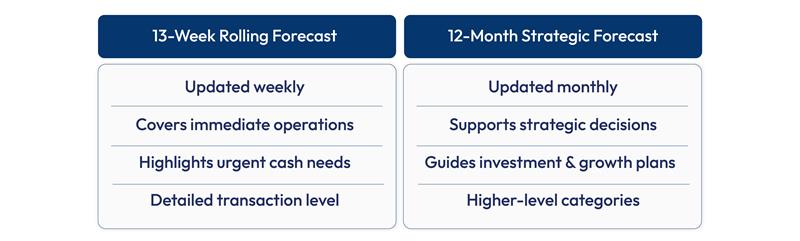
Early warning of cash shortfalls enables proactive solutions such as accelerating collections, negotiating extended supplier terms, or arranging temporary financing. The most common factors affecting Australian businesses include declining revenue (35%), low cash reserves (30%) and seasonal fluctuations (27%), according to CommBank’s research.
2. Budgeting and Variance Analysis
Budgeting and forecasting work in tandem to control cash flow and strengthen financial accounting & management systems.
Budget development includes:
- Revenue projections by product, service, or customer segment
- Fixed cost allocation (rent, salaries, insurance)
- Variable cost planning (materials, marketing, commissions)
- Capital expenditure requirements
- Contingency reserves for unexpected expenses
Variance analysis compares actual performance against budgeted figures monthly. This process identifies:
- Payment timing differences affecting cash availability
- Cost categories exceeding planned levels
- Revenue shortfalls requiring adjustment
- Unexpected expenses impacting cash reserves
Regular variance reviews keep forecasts accurate and enable timely corrective action, a best practice in strategic accounting management.
3. Working Capital Management
Working capital is the difference between current assets and current liabilities directly determines operational cash availability. Management of accounts receivable and accounts payable management are central parts of this process.
Management of accounts receivable:
- Credit policy development and customer assessment
- Clear payment terms on all invoices
- Systematic follow-up on overdue accounts
- Early payment incentives to accelerate collections
- Customer payment pattern analysis
- Systematic follow-up on overdue accounts using accounts management software
Management of accounts payable:
- Strategic payment timing to preserve cash
- Supplier term negotiations
- Early payment discount evaluation
- Payment scheduling aligned with cash inflows
- Supplier relationship balance
Inventory optimisation:
- Turnover rate analysis by product
- Optimal stock level determination
- Just-in-time ordering where appropriate
- Slow-moving inventory identification
- Cash release from excess stock
Effective management of accounts receivable and payables ensures liquidity stability and predictable cash reserves.
4. Cost Accounting and Analysis
Cost accounting reveals exactly where cash is consumed. This analysis supports pricing decisions, identifies cost reduction opportunities and highlights unprofitable activities.
Key cost analysis techniques:
- Product or service profitability assessment
- Department or project cost tracking
- Cost driver identification
- Break-even analysis
- Activity-based costing for accurate allocation
Understanding true costs enables businesses to focus resources on activities that generate positive cash flow while reducing or eliminating cash drains.
Practical Strategies for Cash Flow Optimisation
Implementing management accounting strategies requires more than just understanding concepts it demands action.
Effective accounts management combines systematic processes with strategic thinking to improve both the timing and predictability of cash flows.
These practical approaches help businesses strengthen their financial position immediately.
Accelerating Cash Inflows
Use bookkeeping and accounting software for small businesses to automate invoice creation, follow-ups and reconciliation.
Invoice management:
- Send invoices immediately upon work completion
- Include clear payment terms and due dates
- Accept multiple payment methods (card, direct debit, bank transfer)
- Implement electronic invoicing for faster delivery
Collection practices:
- Follow up on invoices before due dates
- Contact customers promptly when payments are overdue
- Use accounts management software for systematic tracking
- Offer early payment discounts (typically 1-2% for 10-day payment)
- Review credit terms regularly reduce from 60 to 30 days where possible
- Use workflow management for accountants to automate reminders and escalation
Alarmingly, 27% of Australian small business owners have dipped into personal savings or forgone paying themselves in the past year to keep their businesses running, highlighting the severity of cash flow pressures.
Customer management:
- Identify consistently late-paying customers
- Adjust terms or require deposits from problematic accounts
- Explore separately managed accounts for high-value clients to streamline payments
- Recognise and prioritise reliable payers
- Consider factoring or invoice financing for long payment terms
Controlling Cash Outflows
Payment timing strategies:
- Schedule major expenses during strong cash flow periods
- Negotiate instalment plans for large purchases
- Align payment dates with collection patterns
- Take supplier discounts only when financially beneficial
Expense prioritisation:
- Distinguish essential from discretionary spending
- Delay non-critical purchases during tight periods
- Evaluate lease vs purchase options for equipment
- Review subscriptions and recurring expenses regularly
Supplier relationship management:
- Negotiate extended payment terms where possible
- Maintain open communication about cash constraints
- Prioritise payments to critical suppliers
- Build goodwill through reliable payment history
Building Cash Reserves
Management accounting strategies emphasise maintaining reserves equal to three to six months of operating expenses.
Reserve building approach:
- Set aside 5-10% of revenue automatically
- Transfer excess cash to separate accounts
- Build gradually rather than in large chunks
- Use reserves only for genuine emergencies
- Replenish reserves immediately after use
These reserves provide operational security during difficult periods and confidence to pursue growth opportunities.
Maintaining reserves is a crucial aspect of strategic accounting management and improves resilience across operations.
Technology Solutions for Cash Management
Modern technology transforms how businesses approach financial accounting & management, making sophisticated cash management accessible to organisations of all sizes.
The right accounting and project management software, combined with document management system for accountants, creates an integrated control environment that provides real-time visibility and control.
Essential software features:
- Automatic bank feed integration for cash management account visibility
- Invoice creation and tracking with automated reminders
- Expense categorisation and reporting
- Cash flow dashboards and visualisations
- Multi-currency handling for international operations
- Mobile access for remote management
- Integration with accounting practice management software for streamlined operations
Integration capabilities:
- Banking system connections
- Payment processor linkage
- Customer relationship management (CRM) systems
- Inventory management platforms
- Document management systems for accountants
- Accounting workflow management tools
For smaller businesses, bookkeeping and accounting software for small businesses provides advanced yet accessible functionality. Many adopt outsourced bookkeeping or outsourced account management models supported by outsourced accountants who leverage advanced accounts management software for seamless collaboration.
Accounting workflow management automates routine tasks such as invoice generation, payment reminders and expense tracking. This automation reduces errors and frees time for strategic analysis, allowing businesses to focus on growth rather than administrative tasks.
The Duties and Responsibilities of Account Managers in Cash Flow Control
Understanding the duties and responsibilities of an account manager within the management accounting framework setup clarifies how these professionals support business success.
Whether you’re considering hiring internally or exploring outsourced account management, knowing what these roles entail helps you make informed decisions. Account managers serve as the bridge between raw financial data and strategic business decisions.
Core responsibilities include:
- Preparing regular management reports and cash flow forecasts
- Conducting variance analysis and identifying financial trends
- Monitoring key performance indicators (KPIs) related to cash
- Advising on pricing strategies and cost reduction opportunities
- Supporting strategic planning with data-driven insights
- Coordinating budgeting processes across departments
- Implementing and maintaining accounting practice management software
- Ensuring compliance with internal financial controls
Cash management specific duties:
- Tracking accounts receivable ageing and collection activities
- Managing accounts payable schedules strategically
- Monitoring working capital ratios and trends
- Identifying cash flow risks and opportunities
- Recommending financing options when needed
- Liaising with banks and financial institutions
In larger firms, group managed service accounts and control account managers oversee departmental operations, ensuring alignment between finance, operations and compliance. The meaning of a control account manager extends to maintaining oversight of reconciliations and supporting enterprise-level cash visibility.
For SMEs, outsourced account management can fulfil these responsibilities effectively and delivers access to professional expertise at lower costs, often enhanced by document management for accountants’ tools that centralise reporting and compliance documentation. The rise of cloud-based technology means remote account management delivers the same quality and responsiveness as in-house teams, often at a fraction of the cost.
Common Cash Management Pitfalls
Even well-structured management accounting systems face pitfalls; businesses can fall into predictable traps that undermine cash flow. Recognising these common mistakes helps you avoid them.
Understanding where others stumble provides valuable lessons for strengthening your own financial controls.
Confusing Profitability with Cash Flow
Profit and cash are distinct metrics. Accounting recognises revenue when invoiced, not when payment is received. Major purchases may be capitalised over time for accounting purposes but require immediate cash payment.
Management accounting maintains separate tracking of profitability and cash position, preventing dangerous assumptions.
Inadequate Forecast Updates
Annual budgets become outdated quickly. Effective cash management requires:
- Weekly updates to short-term forecasts
- Monthly updates to long-term forecasts
- Immediate adjustments for significant changes
- Regular review of assumptions
Ignoring Future Commitments
Current bank balances don’t reflect upcoming obligations:
- Payroll processing dates
- Tax payment deadlines
- Quarterly rent or lease payments
- Loan repayments
- Seasonal expense variations
Management accounting systems track these commitments and incorporate them into cash projections.
Inconsistent Collection Practices
Sporadic follow-up on overdue accounts weakens cash flow. Systematic processes supported by accounts management software ensure consistent collection efforts and faster payment.
Implementation Roadmap
Establishing effective cash management doesn’t happen overnight, but following a structured approach accelerates results. Whether you’re starting from scratch or improving existing processes, this roadmap provides clear direction. Each step builds on the previous one, creating a comprehensive system that protects and strengthens your cash position.
Step 1: Establish baseline forecasting
- Create a 13-week cash flow forecast
- Document all expected receipts and payments
- Update weekly with actual results
Step 2: Implement monitoring systems
- Select appropriate accounting practice management software.
- Set up bank feed integration for real-time cash management account visibility.
- Configure invoice tracking and automated reminders.
- Establish document management for accountants to organise financial records.
- Implement accounting workflow management (or workflow management for accountants) for consistent processes.
Step 3: Develop analysis processes
- Schedule monthly variance analysis
- Review working capital components
- Analyse cost patterns and drivers
- Identify improvement opportunities
Step 4: Build reserves systematically
- Determine target reserve level
- Establish automatic transfer procedures
- Monitor reserve adequacy regularly
- Adjust contribution rates as needed
Step 5: Refine continuously
- Update forecasting assumptions based on experience.
- Adjust collection and payment practices.
- Optimise working capital management.
- Leverage technology for increased efficiency.
For complex situations or rapid growth, professional support through outsourced account management or part-time specialists provides expertise that prevents costly mistakes and accelerates implementation. Many businesses find that outsourced accountants offer the perfect balance of expertise and cost-effectiveness.
Conclusion
Effective cash management requires accurate information, systematic monitoring and timely decision-making. Management accounting services provide the framework and tools that transform cash management from reactive crisis handling into proactive control.
Implementation of forecasting, variance analysis, working capital optimisation and appropriate technology maintains healthy cash flow during both stable and challenging periods. Investment in management accounting whether through internal resources or outsourced accountants typically returns multiples of its cost through crisis prevention and improved financial performance.
Cash management represents a fundamental business capability, not an optional administrative function. Management accounting delivers the visibility and control that ensures cash availability when needed, supporting operational stability and strategic growth.
Ready to optimise your cash flow? Contact Outbooks Australia today at 0451320102 or email info@outbooks.com.au for expert management accounting services.
Frequently Asked Questions

Parul is a content specialist with expertise in accounting industry. Her writing covers a wide range of domains such as, Accounts Payable, Accounts Receivables, Bookkeeping and more. She writes well-researched content and has a strong understanding of accounting terms and industry-specific terminologies. As a subject matter expert, she simplifies complex concepts into clear, practical insights, helping businesses with accurate tips and solutions to make informed decisions.