
If you’re comparing prices before choosing a payroll provider, you’re asking the right question first. Payroll outsourcing costs in Australia vary depending on the number of employees, pay frequency, payroll complexity and level of support required. Businesses may pay a monthly base fee, a per-employee fee or a charge for each pay run.
Getting the pricing wrong, either by overpaying or choosing a provider that does not meet your business requirements, can cost more than the monthly service fee itself.
This guide breaks down indicative payroll outsourcing costs in Australia for 2026, the pricing models providers use, additional charges to consider, and how outsourcing compares with managing payroll in-house. Whether you’re hiring your first employee or reviewing costs for an existing team, you’ll find useful information to help you budget.
Payroll Outsourcing Cost in Australia (2026)
There is no fixed price for payroll outsourcing in Australia. Costs depend on the provider’s service scope and how frequently employees are paid.
According to published Australian payroll pricing guidance, some providers charge a monthly base fee of approximately $50–$80, plus $6–$20 per payslip per pay run. These are indicative prices rather than fixed industry rates. Fully managed payroll services may have different pricing structures.
The following table provides an example of how these charges can work.
| Pricing component | Indicative cost (AUD) |
|---|---|
| Monthly base fee | $50–$80 |
| Per payslip, per pay run | $6–$20 |
| Additional setup fees | Depends on provider |
| Additional payroll support | Depends on service scope |
For example, a business with 10 employees paid fortnightly would process approximately 260 payslips annually. At $6–$20 per payslip, the annual processing charge would be $1,560–$5,200, plus the monthly base fee.
Actual quotes will vary depending on whether the service includes payroll administration, employee record management, reporting, STP lodgement, superannuation processing and other responsibilities.
Note: These figures are illustrative market pricing references, not Outbooks’ service prices. Always request a customised quotation before making a decision.
Common Payroll Outsourcing Pricing Models in Australia
Payroll providers in Australia generally use one or a combination of the following pricing models.
1. Per Employee Per Month (PEPM)
Businesses pay a fixed fee for each employee processed during the month. This model is suitable for small businesses with a relatively stable workforce.
The overall cost increases as the number of employees grows. However, it can make monthly budgeting easier when the provider offers a consistent per-employee rate.
2. Flat Monthly Fee
A fixed monthly price covers an agreed range of payroll services and employee numbers.
This model is useful for businesses that prefer predictable monthly expenses. However, check whether the package includes additional payroll runs, employee changes and reporting.
3. Base Fee Plus Per Employee
This pricing model combines a fixed monthly charge with an additional fee for each employee.
For example, a provider may charge a monthly base fee of $60 plus $10 per employee. A business with 15 employees would pay $210 per month.
This approach can work well for businesses that want a predictable base cost with flexibility as their workforce changes.
4. Per Pay Run Pricing
Some payroll providers charge for every payroll cycle rather than using a monthly subscription.
The cost depends on the number of employees included in each pay run and the complexity of payroll calculations.
Businesses processing payroll weekly may pay more throughout the year than those processing it fortnightly or monthly.
5. Custom Pricing
Larger organisations or businesses with complex payroll requirements may receive customised quotations.
Factors such as multiple locations, different award classifications, employee benefits, reporting requirements and payroll integrations can influence the final price.
Payroll Outsourcing Cost by Business Size
The number of employees is one of the main factors affecting payroll outsourcing costs. However, business size alone does not determine the final quotation.
A business with 15 employees working under different award classifications may require more payroll administration than a business with 30 salaried employees.
| Business size | Typical payroll requirements | Pricing considerations |
|---|---|---|
| Small (1–20 employees) | Basic payroll processing, payslips and employee records | Base fees and per-employee charges |
| Medium (21–100 employees) | Regular payroll runs, employee changes and reporting | Volume pricing and service complexity |
| Large (100+ employees) | More complex payroll administration and reporting | Custom quotations and integration requirements |
These categories describe typical service requirements, not guaranteed monthly price ranges. Request quotations based on your actual employee numbers, pay frequency and required services.
Cost Per Employee vs Cost Per Pay Run
Understanding the difference between these pricing models helps businesses compare payroll providers more accurately.
- Per employee: You pay according to the number of employees included in the payroll service.
- Per pay run: You pay each time payroll is processed.
- Per payslip: You pay for each payslip generated during a payroll cycle.
For example, a business with 20 employees paid fortnightly has approximately 520 payslips to process annually.
A provider charging per payslip may calculate its fees differently from one charging a fixed monthly amount.
When comparing quotations, check whether the quoted price covers one employee for a month or one employee for each pay run. These are different pricing arrangements.
Factors Influencing Payroll Outsourcing Costs
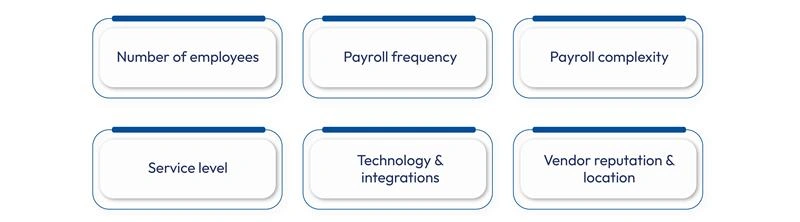
Several factors affect how much Australian businesses pay for outsourced payroll services.
1. Number of Employees
Larger workforces generally increase the total cost of payroll processing. However, providers may offer lower per-employee rates for higher employee volumes.
2. Payroll Frequency
Businesses processing payroll weekly may incur higher annual costs than those using fortnightly or monthly payroll cycles.
More frequent payroll runs can mean additional administration and processing charges.
3. Payroll Complexity
Payroll involving different award rates, overtime, allowances, commissions, bonuses and deductions requires more detailed calculations.
Businesses with multiple employee classifications may therefore receive higher quotations.
4. Level of Service
Basic payroll processing generally costs less than a fully managed service.
Some providers offer additional services such as employee onboarding, payroll reporting, leave administration and employee query management.
5. Technology and Software Integrations
Payroll providers may use cloud-based accounting and payroll platforms such as Xero, MYOB and Sage.
Integration requirements, software subscriptions and customised reporting can affect the overall cost.
6. Payday Super Requirements
From 1 July 2026, Payday Super requires employers to pay superannuation contributions in connection with each payday, rather than following the previous quarterly payment cycle.
This change can affect payroll administration, payment scheduling and the processes used to manage superannuation contributions.
Businesses should check whether their payroll provider supports Payday Super-related calculations, reporting and payment processes, and whether these services are included in the quoted price.
How Payday Super Affects Payroll Outsourcing Costs in Australia (2026)
Payday Super is an important consideration when comparing payroll providers in 2026.
From 1 July 2026, employers must generally ensure that superannuation contributions reach employees’ super funds within seven business days after payday, subject to applicable exceptions.
The superannuation guarantee rate remains 12% of qualifying earnings.
This change means businesses need to review their payroll processes and ensure that superannuation calculations and payments are managed within the required timeframes.
Here are some important points to consider:
- More frequent processing: Superannuation contributions need to be managed in line with each pay cycle.
- Cash flow planning: Businesses need to plan for superannuation payments more frequently.
- Payroll software: Existing payroll systems should support the updated superannuation requirements.
- Provider responsibilities: Confirm whether your provider handles calculations, reporting and payment processing or whether these remain your responsibility.
- Additional charges: Check whether any additional service fees apply to superannuation administration.
Important: Outbooks does not pay superannuation contributions on behalf of clients. Businesses using Outbooks should arrange superannuation payments through their own processes or an appropriate provider.
Common Hidden Costs of Payroll Outsourcing and How to Avoid Them
The advertised monthly fee may not cover every service. Before signing an agreement, check whether the following additional charges apply.
1. Setup Fees
Some providers charge a one-off fee for setting up payroll systems, transferring employee records and configuring payroll information.
Ask whether onboarding costs are included in the initial quotation.
2. Additional Service Charges
Extra charges may apply for employee terminations, additional payroll runs, customised reports and other services outside the agreed package.
3. Software and Integration Costs
Payroll software subscriptions, system integrations and additional licences may be billed separately.
Check whether these costs are included in the provider’s monthly fee.
4. Additional Compliance Support
Some providers charge extra for specialist payroll support, award interpretation and compliance-related services.
Clarify exactly what level of support is included.
5. Contract Lock-ins
Long-term contracts may include cancellation charges or fixed service fees.
Review the agreement carefully and understand how pricing changes as your business grows.
Tips to Avoid Unexpected Costs
- Request a detailed fee schedule before signing an agreement.
- Confirm what is included in the standard service package.
- Ask about additional payroll runs and employee changes.
- Check software and integration charges.
- Review contract terms and cancellation conditions.
- Compare the total annual cost rather than just the monthly subscription.
In-House Payroll vs Outsourced Payroll: Cost Comparison
Businesses often compare the cost of hiring an internal payroll employee with outsourcing payroll administration.
However, the actual cost of in-house payroll includes more than an employee’s salary.
| Cost aspect | In-house payroll | Outsourced payroll |
|---|---|---|
| Staffing | Employee salary, superannuation and other employment costs | Service fees paid to the provider |
| Software | Payroll software licences and maintenance | May be included or charged separately |
| Training | Internal training and professional development | Provider manages its own payroll team |
| Administration | Managed by internal employees | Agreed tasks handled by the provider |
| Scalability | May require additional employees as the business grows | Service scope can be adjusted |
| Management | Internal supervision and quality checks | Provider coordination and client approvals |
| Compliance responsibilities | Managed internally | Depends on the agreed service scope |
Which Option Is More Cost-Effective?
Outsourcing can be more cost-effective for small and medium-sized businesses that do not need a dedicated payroll employee.
It can reduce the time spent on routine payroll administration and provide access to experienced payroll professionals without the cost of maintaining a full-time internal team.
However, businesses should compare the total cost of both options, including software, management time, training and additional service fees.
What Services Are Included in Payroll Outsourcing?
The services included in outsourced payroll packages vary between providers.
Depending on the agreement, payroll outsourcing may cover:
- Wage and salary calculations.
- PAYG withholding calculations.
- Payslip preparation.
- Leave balance calculations and administration.
- Employee record updates.
- Payroll reporting.
- Payroll payment preparation.
- Superannuation calculations and payment administration.
- Single Touch Payroll (STP) reporting.
Not every provider offers all these services. Some handle payroll calculations and payslips, while others provide more comprehensive payroll administration.
Before choosing a provider, confirm which responsibilities they handle and which remain with your business.
How to Set Up Payroll for a Small Business in Australia
If you’re setting up payroll for the first time, understanding the basic requirements can help you avoid unnecessary expenses and administrative problems.
Here are the main steps:
- Register your business: Obtain an Australian Business Number (ABN) and register for PAYG withholding if you employ workers and have withholding obligations.
- Collect employee information: Obtain the required employee details, including Tax File Number declarations, bank details and superannuation fund information.
- Choose a payroll system or provider: Decide whether to manage payroll internally or use an outsourced payroll service.
- Calculate employee wages: Work out gross pay, PAYG withholding, superannuation and applicable deductions.
- Prepare payslips: Provide employees with payslips within the required timeframe.
- Manage payroll payments: Arrange wage payments and meet applicable tax and superannuation obligations.
- Maintain employee records: Keep accurate payroll and employment records in accordance with Australian requirements.
Australian employers must generally retain employment records for seven years under Fair Work requirements. Many tax records must be retained for at least five years, although specific requirements and exceptions apply.
Following the correct procedures from the beginning helps businesses manage payroll more efficiently and avoid unnecessary compliance problems.
Choosing the Right Payroll Service Provider in Australia
Once you understand the costs, the next step is selecting a provider that meets your business requirements.
Consider the following factors before signing an agreement.
Compliance Knowledge
Check the provider’s understanding of Australian payroll processes, PAYG withholding, superannuation requirements and relevant Fair Work obligations.
Confirm exactly which compliance-related responsibilities the provider undertakes.
Technology and Integration
Check whether the provider can work with your existing accounting and payroll software.
Compatibility with platforms such as Xero, MYOB and Sage can help streamline payroll administration.
Service Range
Ensure the provider offers the services your business needs, including payroll processing, payslip preparation, employee record updates and reporting.
Cost Transparency
Look for clear pricing without unexpected setup fees, additional processing charges or software costs.
Data Security
Payroll involves confidential employee information. Confirm that the provider has appropriate security measures, access controls, encryption and data protection procedures.
Also check how the provider handles employee information in accordance with the Privacy Act 1988 (Cth) and applicable Australian Privacy Principles.
Customer Support
Check the availability of support through phone, email or other communication channels.
Ask how payroll errors, employee queries and urgent processing changes are handled.
Before making a decision, request a detailed quotation, understand the service agreement and confirm who is responsible for each payroll obligation.
Questions to Ask Payroll Companies Before Outsourcing
Before choosing a payroll provider, ask the following questions:
- What services are included in your payroll outsourcing package?
- How is your pricing structured, and are there any additional fees?
- Do you charge per employee, per payslip or per pay run?
- How do you manage payroll changes and employee terminations?
- What security measures protect employee payroll information?
- Can you work with our existing accounting and payroll software?
- How do you handle payroll errors and adjustments?
- What support is available when urgent payroll changes are required?
- How do you support businesses with Payday Super requirements?
- Which payroll responsibilities remain with our business?
Asking these questions will help you compare providers and understand the actual value included in their quotations.
Conclusion
Payroll processing, especially for small businesses, can be complex and time-consuming. Outsourcing payroll to a specialist provider can reduce administrative workloads, improve processing efficiency and give businesses access to experienced payroll professionals.
Understanding pricing models, additional fees and service responsibilities helps businesses choose a suitable payroll solution.
Before selecting a provider, compare the total cost, understand what is included and make sure the service matches your business requirements.
Choose Outbooks Australia for Payroll Processing Support
Managing payroll doesn’t have to take time away from running your business. Outbooks Australia provides payroll processing support to help businesses manage wage calculations, deductions, leave, payslips and payroll reporting.
Our team can work with your existing payroll platform, including Xero, MYOB and Sage, to support your regular payroll administration.
Our service includes preparing payment batches for your approval and handling agreed employee record updates and payroll reporting.
To understand how our services can support your business, explore our payroll processing services.
Please note: Outbooks does not file Single Touch Payroll (STP), pay superannuation contributions, provide SMSF services or advise on pay rates or legal requirements, including tax rates applicable to non-residents working in Australia.
For more information, contact our team:
- Email: info@outbooks.com.au
- Phone: 0451 320 102
Get in touch with Outbooks Australia to discuss your payroll processing requirements.
Frequently Asked Questions About Payroll Outsourcing Costs in Australia
1. How much does it cost to outsource payroll in Australia?
Payroll outsourcing costs vary according to employee numbers, pay frequency and service requirements. Some published pricing guides indicate a monthly base fee of around $50–$80, plus $6–$20 per payslip per pay run. Fully managed services may cost more.
2. What factors affect payroll outsourcing costs for small businesses?
The main factors include the number of employees, payroll frequency, award complexity, software requirements, employee changes and the level of support included in the service package.
3. Is outsourcing payroll cheaper than running payroll in-house?
Outsourcing can be more cost-effective for businesses that do not need a dedicated payroll employee. It can reduce staffing, software and training expenses. However, the actual savings depend on the size of the workforce and the services required.
4. What services are included in outsourced payroll packages?
Depending on the provider, services may include wage calculations, PAYG withholding, payslip preparation, leave administration, employee record updates and payroll reporting. Some providers also offer STP reporting and superannuation administration.
5. Do payroll service providers in Australia charge per employee or per pay run?
Both pricing models are common. Some providers charge a monthly fee for each employee, while others charge for every payslip or payroll cycle. Always check the pricing structure before signing an agreement.
6. How do payroll companies work with small businesses?
Payroll providers generally collect employee and payroll information, process agreed payroll tasks, prepare payslips and provide payroll reports. The exact responsibilities depend on the service agreement.
7. What is the payroll outsourcing process?
The process generally involves an initial consultation, reviewing existing payroll arrangements, collecting employee information, setting up system access, agreeing on payroll schedules and beginning regular payroll processing.
8. What are the benefits of outsourcing payroll for small businesses?
The main benefits include saving administrative time, reducing internal workload, improving payroll processes, accessing experienced professionals and scaling services as the business grows.
9. How can I set up payroll for a small business with one employee?
You can start by registering for the required tax obligations, collecting employee information, choosing payroll software or an outsourcing provider, calculating wages and meeting payslip, tax and superannuation requirements.
10. When should a business consider moving from in-house payroll to outsourcing?
A business should consider outsourcing when payroll administration takes too much internal time, payroll errors become frequent, compliance requirements become more complex or the business grows beyond its existing payroll capacity.