
There’s no single fixed price for AP outsourcing in Australia, but a business can still get a reasonably clear estimate before requesting quotes. Hourly PAYG arrangements for straightforward AP support commonly sit in the range of $35 to $60 per hour, depending on scope and complexity, while fixed monthly fees for a defined scope of work typically run from a few hundred dollars for a small, single-entity business up to several thousand dollars a month for a business with higher invoice volume, multiple entities, or more complex reporting needs.
Those figures are a starting point, not a quote. The actual cost for your business depends on invoice volume, the scope of AP work you want covered, how many entities and bank accounts are involved, your existing software, and which of the pricing models below applies.
This guide explains how those factors combine, walks through illustrative cost calculations, and shows how to compare quotes from different providers on a like-for-like basis.
Key Takeaways
- Hourly PAYG rates for AP outsourcing in Australia typically range from around $35 to $60 per hour, while fixed monthly fees vary from a few hundred to several thousand dollars depending on scope and volume
- Outbooks offers four engagement models: Staff Augmentation, PAYG/Ad Hoc, Managed Service and Fixed Fee Per Month
- Comparing outsourcing against an in-house AP hire means accounting for salary, superannuation, recruitment and management time, not just the outsourced quote
- The quoted rate does not tell you the full cost. Check what’s included, what’s excluded, and whether GST coding, entity count or reporting complexity push the price higher
How Much Does AP Outsourcing Actually Cost? Illustrative Examples
Rather than quoting a single figure, it’s more useful to see how the cost is actually built up. The two scenarios below are illustrative only, based on assumed volumes and rates, not advertised pricing, since your actual quote will depend on your specific requirements.
Scenario A: A small single-entity business
Around 150 invoices a month, standard GST coding, using Xero. On a PAYG model at an illustrative rate of $40 an hour, covering roughly 10 hours of processing a month, this works out to approximately $400 a month before any exceptions or additional entity work.
Scenario B: A mid-sized business with multiple entities
Around 600 invoices a month across two entities, with some project-based coding. On a Fixed Fee Per Month model, a quote for this level of complexity might land somewhere between $1,200 and $2,500 a month, depending on how much of the AP cycle, beyond basic processing, is included in that fee.
The gap between these two scenarios comes down to volume, entity count and coding complexity, the same factors covered in more detail below.
What Are the Different AP Outsourcing Pricing Models?
AP outsourcing providers structure their services in different ways. The right model depends on how much AP work you need covered, how consistent your workload is, and whether you need ongoing support or help on demand.
At Outbooks, AP support is available through four engagement models: Staff Augmentation, PAYG/Ad Hoc, Managed Service and Fixed Fee Per Month. Each is built around a different level of involvement and cost structure.
Outbooks Engagement Models
| Engagement model | How it works | Suited to |
|---|---|---|
| Staff Augmentation | A dedicated remote professional works exclusively for your firm, follows your working hours and can be selected through onboarding. | Firms that need ongoing AP support and continuity with a dedicated resource. |
| PAYG/Ad Hoc | Professionals are engaged on an hourly basis, with weekly timesheets and billing based on hours used. | Firms with variable or seasonal requirements, or a one-off need for additional support. |
| Managed Service | Outbooks manages the AP work end to end under an agreed fee structure, based on the scope of services required. | Accounting firms that want AP managed without handling day-to-day processing themselves. |
| Fixed Fee Per Month | A set monthly fee is agreed based on the defined scope and expected task volume. | Businesses that want a predictable monthly cost for an agreed set of AP activities. |
Under Outbooks’ Staff Augmentation model, the engagement has a minimum six-month term. PAYG/Ad Hoc is designed for shorter or variable requirements. Terms, inclusions and conditions can vary by engagement, so confirm these before entering an agreement. Full details are available on the Outbooks Australia engagement models page.
How Is AP Outsourcing Priced in Australia?
Two businesses can request AP outsourcing and receive very different quotes because the underlying work is different.
| Cost factor | Why it affects the cost |
|---|---|
| Invoice volume | More invoices means more processing time |
| Scope of work | Scope of work |
| Number of entities and bank accounts | Entities and bank accounts |
| Software and integrations | Software and integrations |
| GST and coding complexity | GST and coding complexity |
| Reporting requirements | Reporting requirements |
GST coding accuracy matters specifically because it feeds directly into your BAS. The ATO requires most businesses to report and pay GST quarterly if turnover is under $20 million, monthly if turnover is $20 million or more, or annually in limited circumstances for voluntary registrants under the relevant threshold. An AP provider correctly coding GST on every invoice as it’s processed reduces the reconciliation work needed before each BAS lodgment, which is worth factoring into scope discussions.
What Is Included in an AP Outsourcing Quote?
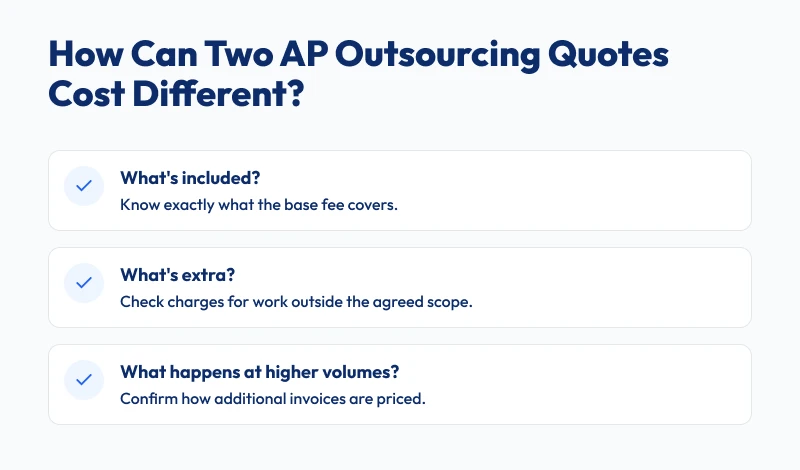
The scope of work is just as important as the quoted rate. A lower headline price may cover a narrower set of activities, while another quote may include additional processing, reporting or support.
Ask each provider to clearly separate included services, excluded services and additional charges.
| Typically covered within an agreed AP scope | Charges or requirements to check separately |
|---|---|
| Invoice receipt and verification | Rush or same-day processing |
| Invoice coding and matching | Exception handling above an agreed threshold |
| Standard payment scheduling | Additional multi-entity work |
| Vendor record maintenance | Custom or ad hoc reporting |
| Standard monthly reporting | Software setup or migration |
These are examples of items to clarify with the provider. The actual inclusions depend on the engagement and scope agreed for your business.
AP Outsourcing vs. In-House: What to Compare
Outsourcing isn’t automatically cheaper than hiring in-house, and it isn’t automatically more expensive either. Both comparisons depend entirely on your specific volume and structure, so it’s worth setting out what to actually compare rather than assuming a general answer.
Salary: According to SEEK’s published salary data, an Accounts Payable Officer role in Australia typically pays in the range of $51,000 to $65,000 a year, with senior roles ranging higher. This is the base cost before anything else is added.
Superannuation: From 1 July 2025, employers are required to pay superannuation guarantee contributions of 12% of an employee’s ordinary time earnings, on top of salary, which adds a meaningful amount to the total cost of an in-house hire.
Recruitment and training: Advertising a role, screening candidates and onboarding a new hire all carry a cost, and a new AP employee typically needs time to become familiar with your specific suppliers, coding structure and approval process before reaching full productivity.
Management and oversight: An in-house AP employee needs someone to manage performance, cover leave and step in during absences, which is time a manager or business owner spends that doesn’t show up as a direct payroll cost but is real nonetheless.
Software and tools: Whether AP is handled in-house or outsourced, the accounting software itself carries a cost, though an outsourced provider may already have relevant tools and integrations in place.
To make a fair comparison, add up your actual or estimated cost across these categories and compare that total to an outsourcing quote covering the same scope of work. Which option costs less depends entirely on your specific numbers, not on a general rule either way.
How to Compare AP Outsourcing Quotes
Once you’ve received proposals, avoid comparing headline rates alone. Work out what each option would cost based on the same scope and your expected level of activity.
1. Define the AP Work You Need Covered
List the activities you want to outsource, invoice processing, coding and matching, payment preparation, supplier queries, reconciliations and reporting. A clear scope gives each provider the same starting point.
2. Confirm the Engagement Model
Identify whether the proposal is based on Staff Augmentation, PAYG/Ad Hoc, Managed Service or Fixed Fee Per Month, since each structures the cost differently.
3. Apply Your Expected Workload
Use your actual or expected monthly invoice volume. If pricing is volume-based, ask for the rate that applies to your expected volume rather than the lowest advertised tier. For a fixed monthly arrangement, confirm what level of activity is included and what happens above the agreed scope.
4. Check the Scope and Exclusions
Ask the provider to identify anything that falls outside the quoted service, including urgent processing, exceptions, additional entities, custom reporting or software changes.
5. Calculate the Expected Monthly Cost
For a volume-based arrangement: applicable rate × expected monthly volume + recurring additional charges = expected monthly cost. For a fixed-fee or dedicated-resource model, use the agreed monthly fee as the starting point and add any recurring extras. Keep one-off onboarding or setup fees separate, since they affect your first-year cost but aren’t part of the recurring monthly figure.
6. Compare the Proposals on the Same Basis
Look at monthly recurring cost, one-off setup costs, activities included, volume or scope limits, additional charges, contract term, and service and reporting requirements.
What to Provide When Requesting an AP Outsourcing Quote
To get an accurate, comparable quote, give each provider the same information upfront:
- Expected monthly invoice volume
- Number of entities and bank accounts involved
- Accounting software currently in use, such as Xero, MYOB or QuickBooks
- Which AP activities you want outsourced, from processing through to reconciliation
- Any multi-currency or AUD cross-border transactions that need handling
- Reporting requirements beyond a standard monthly pack
- Payment processes and approval requirements specific to your business
The more clearly this is defined upfront, the easier it is to compare quotes on a like-for-like basis rather than discovering gaps in scope after signing.
What Should You Ask Before Choosing a Provider?
Before signing, confirm:
- Contract terms: What’s the minimum commitment, and what are the notice and termination requirements?
- Cost changes: If your scope or volume changes, how will the revised fee be calculated?
- Service responsibility: Who handles the work, reviews it, and acts as your point of contact?
- GST accuracy: How does the provider confirm invoices are coded correctly for your BAS before lodgment?
Conclusion
There’s no single figure that applies to every business, because AP outsourcing costs scale with volume, scope and complexity, and a fair in-house comparison depends on your specific salary, superannuation and management costs rather than a general assumption either way. Working through the illustrative scenarios, cost factors and comparison steps in this guide gives you a realistic basis for evaluating a quote against your actual requirements.
If you want help understanding which AP outsourcing arrangement fits your business, book a consultation with Outbooks or contact the team at info@outbooks.com.
FAQs
How much does AP outsourcing cost for a small business in Australia?
For a small, single-entity business with straightforward invoicing, hourly PAYG support often falls in the range of $35 to $60 an hour, though actual pricing depends on volume and scope. Request a quote based on your specific invoice volume for an accurate figure.
Is outsourcing accounts payable cheaper than hiring in-house?
It depends on your volume and structure. Compare your full in-house cost, salary, superannuation at 12% from July 2025, recruitment and management time, against an outsourcing quote covering the same scope before drawing a conclusion either way.
What factors affect AP outsourcing costs?
Invoice volume, scope of work, number of entities and bank accounts, software and integrations, GST and coding complexity, and reporting requirements. The engagement model and any work outside the agreed scope also affect the final cost.
What’s usually excluded from an AP outsourcing quote?
Items that may require separate pricing include rush processing, exception handling above an agreed threshold, additional entity work, custom reporting, and software setup or migration. Ask the provider to identify exclusions in writing.
Does AP outsourcing pricing differ by industry?
The industry itself doesn’t set the price, but the type of AP work required does. Businesses with project-based coding, multiple entities, multi-currency transactions or more complex GST treatment typically require more processing and review than businesses with simpler AP requirements.