



Running a hospitality business in Australia is expensive and operationally demanding. Margins are tight, staffing changes frequently and transactions move quickly across food, drink and accommodation.
Annual revenue for cafes, restaurants and takeaway food services in Australia neared $64 billion in 2023, yet despite that scale, rent alone constitutes roughly 10–15% of a hospitality business’s revenue and labour remains the single largest controllable cost. For most operators, accounting and compliance is one more financial pressure they are managing without dedicated support.
At the same time, you are expected to keep records accurate, meet your filing obligations and stay compliant with Australian regulatory requirements.
Outsourcing hospitality accounting helps address both challenges. It reduces overall accounting cost compared to in-house teams and improves accuracy in payroll and financial reporting.
This guide explains how it works, where the cost difference comes from and how accounting outsourcing improves financial control for hospitality businesses.
Key Takeaways
- Outsourcing can reduce accounting cost compared to in-house teams
- Accuracy improves through regular reviews, reconciliations and expert oversight
- AI helps with speed, but human accountants ensure compliance and correctness
- Hospitality businesses benefit from sector-specific accounting expertise
Why Hospitality Accounting is More Complex?
Hospitality accounting in Australia is not straightforward bookkeeping. The structure of the industry creates ongoing financial pressure and complexity.
Common Challenges:
- Multiple revenue streams: Food, alcohol, accommodation and events all require separate tracking.
- Charge complexity: Different treatment applies across service types, increasing the risk of misclassification when submitting returns.
- High staff turnover: Payroll changes frequently, including part-time, casual and seasonal staff.
- Cash and POS transactions: High transaction volume increases the effort required to keep records reconciled.
- Seasonal income fluctuations: Forecasting and cash flow planning become more difficult when revenue is uneven across the year.
These challenges are exactly why many hospitality businesses move to outsourcing accounting. The combination of structured processes and sector experience reduces both cost pressure and error risk.
How Outsourcing Reduces Accounting Cost?
Most businesses compare outsourcing against a salary. That comparison misses most of what an in-house hire actually costs.
The Processing Layer has Shifted:
A full-time in-house bookkeeper spends a significant portion of their week on work that accounting software and AI now handle automatically.
Transaction matching, receipt processing, payroll calculations, draft reports. These tasks still need to happen, but they no longer require a person dedicated to doing them manually.
What You are Actually Paying for:
When you outsource, that processing layer is handled through automation. What you are paying for is the part that automation cannot do: reviewing outputs for errors, sense-checking numbers against what the business actually did and applying judgement where software produces a result but cannot tell you whether it is right.
That is a materially different cost structure. You are not funding a full workload. You are funding oversight and expertise applied to work that has already been processed.
Labour costs in hospitality typically run between 30–45% of revenue, one of the highest ratios of any industry. When payroll and accounting are both managed in-house, back-office staffing compounds an already stretched cost base.
How Outsourcing Improves Accuracy?
Cost saving is only one part of the decision. Accuracy is where outsourcing creates long-term value.
Hospitality businesses deal with complex rules, frequent payroll changes and high transaction volumes. These are the areas where errors usually happen.
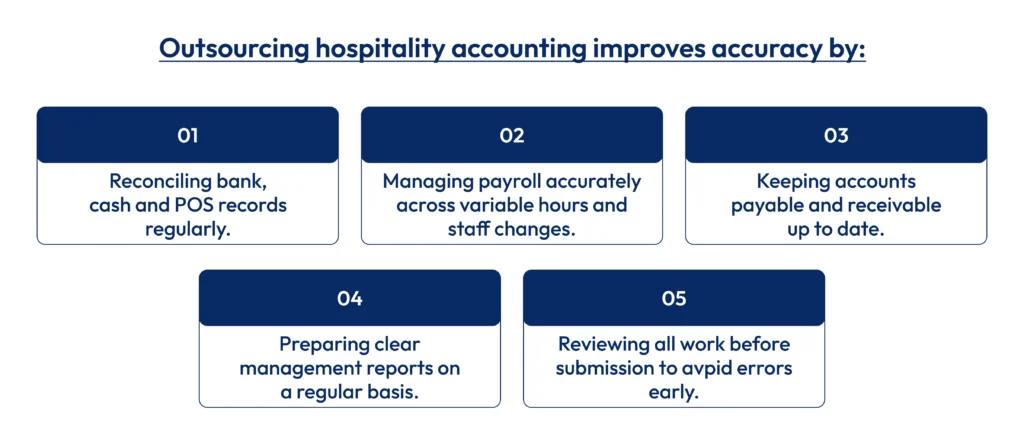
This results in cleaner records, fewer corrections and more reliable reporting.
What Outsourcing Hospitality Accounting Includes?
A good outsourcing provider does more than basic bookkeeping. For hospitality businesses in Australia, a full-service engagement typically covers:
- Day-to-day transaction recording and bookkeeping
- Bank reconciliation and data entry
- Payroll processing
- Accounts payable and receivable management
- Management accounts and monthly reporting
- Cash flow tracking and forecasting
The right provider will work within your existing Xero or QuickBooks setup without requiring a platform change and will scale with your business as workload grows or seasonal demand shifts.
A smart outsourcing provider like Outbooks also takes AI’s help in routine accounting works like:
- Processes invoices and receipts quickly
- Matches transactions automatically
- Categorises routine entries
- Generates draft reports
This reduces manual work and improves speed.
However, expertise and monitoring is still required in many areas. Some of those are mentioned below.
- Cannot reliably apply complex rules
- Struggles with unusual or mixed transactions
- Cannot explain decisions to business owners or regulators
- Cannot adapt easily to regulatory changes
- Requires human setup and ongoing review
AI can also produce incorrect outputs with confidence, especially when dealing with incomplete or complex data. This creates risk if not properly reviewed.
Accounting is not just about processing data. It involves judgement, interpretation and communication.
This is particularly important when dealing with the ATO, where accuracy and clarity are critical.
Choosing the Right Outsourcing Provider
The Australian Hotels and Resorts sector alone is valued at $14.8 billion in 2026, with industry revenue growing at a CAGR of 12% over the past five years. At the same time, operational costs are compounding, recruitment, retraining and lost productivity have become a major financial drain that directly erodes profitability, making the choice of accounting partner more consequential than it was a few years ago.
The right provider makes a material difference to both cost and outcomes. For hospitality businesses, the most important criteria are experience with the sector, the ability to manage complex payroll across casual, part-time and seasonal staff, use of cloud accounting tools and a clear approach to reporting and communication.
Check that the provider works within your existing software setup, offers flexible engagement without a lock-in period and is transparent about exactly what is and is not included in the monthly fee.
Outbooks works with hospitality businesses across Australia, combining accounting expertise with technology to deliver accurate, reliable financial management.
Your Trusted Outsourced Accounting Partner.
Get Started TodayConclusion
Outsourcing hospitality accounting is not just a cost decision. It is a way to improve accuracy, reduce risk and gain better financial control.
AI is a useful tool, but it cannot replace professional judgement. The best results come from combining automation with experienced accountants who understand both the numbers and the business behind them.
For hospitality businesses dealing with tight margins and complex compliance, this approach is both practical and reliable.
If you would like to discuss how outsourcing accounting could work for your hospitality business, the Outbooks Australia team is available to help. Reach out directly at info@outbooks.com.au or call 0451 320 102, no obligation, just a straightforward conversation about your needs.
Frequently Asked Questions

Parul is a content specialist with expertise in accounting industry. Her writing covers a wide range of domains such as, Accounts Payable, Accounts Receivables, Bookkeeping and more. She writes well-researched content and has a strong understanding of accounting terms and industry-specific terminologies. As a subject matter expert, she simplifies complex concepts into clear, practical insights, helping businesses with accurate tips and solutions to make informed decisions.