



Every growing business reaches a point where the work grows faster than the owner expects. More customers mean more invoices. More employees mean more payroll. More suppliers mean more reconciliations. Eventually, one person cannot keep everything current.
That is when reports get finished late, reconciliations go unmanaged and decisions get made using numbers that no longer reflect what is actually happening.
Outsourcing accounting services solve that problem by adding capacity, not by cutting cost. A business gains a team that spreads the work across specialist functions instead of relying on one person for everything. Whether that change is needed depends less on business size than on how much volume and complexity the business now has to manage.
Key takeaways
- Outsourcing solves capacity problems more than cost problems.
- Most providers handle bookkeeping, payroll, reconciliations and reporting through a dedicated team.
- The right time to outsource depends on workload and complexity, not revenue alone.
- Delayed reporting, growing backlogs and increasing transaction volume are practical signs it’s time to review your setup.
- A clear scope, reporting schedule and provider fit matter more than choosing the lowest price.
What actually changes when you Outsource Accounting Services?
The advantages of outsourcing accounting show up in three concrete changes: coverage during leave or turnover, the reliability of the reporting schedule and how quickly errors get caught in routine work.
While the exact impact varies from one business to another, these three operational improvements are the ones businesses notice most often.
Coverage stops depending on one person
A business with a single internal bookkeeper who takes four weeks of leave typically returns to a backlog that takes almost as long to clear.
Reconciliation simply stalls until that person is back at their desk. A team keeps the function running through the same leave, because the knowledge lives in documented processes rather than in one person’s memory.
Reporting becomes a Scheduled Task
For example, there is a business that used to receive its profit and loss report three weeks into the following month, well after spending decisions for that month had already been made. Once a team owns the schedule, that same report is finished on the same agreed date every time. Producing it becomes someone’s assigned task for that week, rather than something fitted in after everything else.
Errors surface within days, not months
A duplicate invoice or a miscategorised expense is more likely to turn up during a routine weekly reconciliation than during an annual review.
A business growing from five employees to fifteen can absorb the extra reconciliation load without hiring a second internal bookkeeper. A team distributes the additional volume across several people instead of piling it onto one person’s workload.
None of these improvements come from changing accounting software. They come from changing how the work is managed. Instead of one person handling every task, different responsibilities are distributed across a team with dedicated ownership.
What Outsourcing Accounting Services include?
Outsourced accounting covers major core functions. What sits inside each one determines whether a business gets the coverage described above, or only part of it.
| Service | What It Covers |
|---|---|
| Bookkeeping | Recording day-to-day transactions and maintaining accurate financial records |
| Bank reconciliation | Matching transactions against bank feeds on a regular schedule |
| Accounts receivable and payable | Managing what the business owes and what it is owed |
| Payroll processing | Running pay cycles and maintaining employment records |
| Management reporting | Monthly profit and loss, balance sheet and cashflow summaries |
Most businesses don’t outsource every accounting task on day one. Some start with bookkeeping and reconciliations before adding payroll or reporting as the business grows. The exact combination depends on where the pressure exists, not on a fixed service package.
Choosing an Engagement Model
Outbooks offers two ways to structure the arrangement for businesses:
| Engagement Model | Best Suited To |
|---|---|
| Staff Augmentation (FTE) | A business that wants one dedicated remote professional working exclusively for them, on the business’s own working hours, with the option to interview candidates first. |
| Fixed Fee Per Month | A business that prefers a set monthly cost, with work scoped to an agreed number of tasks. |
Both engagement models allow a business to move between them, or scale support up or down, as needs change.
Why Capacity and Expertise matter more than Cost at Scale?
Whether capacity and expertise matter more than cost as the argument for outsourcing depends on how much the business actually has to manage.
When an In-House Setup still works well
A sole trader issuing a handful of invoices a month, with no employees and one or two regular suppliers, often finds a single bookkeeper handles the workload without strain.
There is not enough volume or complexity yet for specialist coverage to add much beyond what one capable person already provides.
An in-house approach at this scale is not a weaker choice. It is a setup matched to the size of the job it needs to do.
When the Same Setup starts to Strain
A business with ten employees, several suppliers and monthly reporting obligations manages a very different volume of moving parts.
The gap tends to appear gradually, not overnight. A single bookkeeper who previously handled everything comfortably starts falling behind on reconciliation during busy weeks. There isn’t enough time left for payroll and reporting once a growing invoice volume takes up the hours both need.
That is the point where the accounting function often shifts from one person managing every responsibility to a team with dedicated ownership of each area.
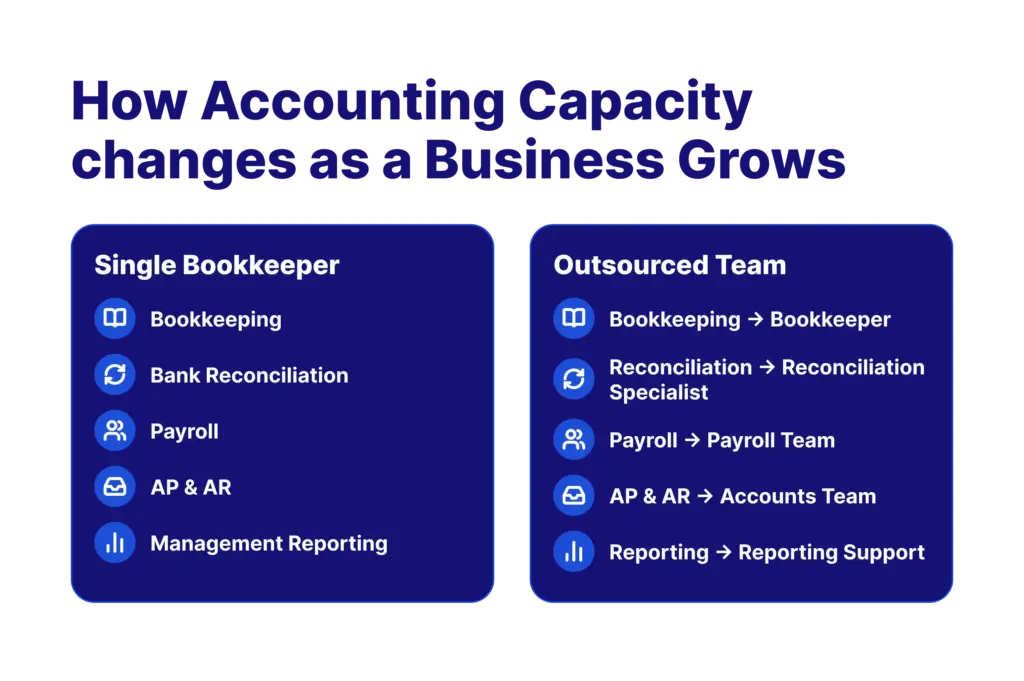
This structure allows additional work to be shared across specialists instead of continuing to build on one person’s workload. As transaction volumes increase, each function keeps moving without competing for the same person’s time.
Platforms like Xero and MYOB give that team the same real-time access to the books as an internal hire, from anywhere, which is what makes the switch practical rather than disruptive.
The Cost Difference Between an In-House Hire and Outsourcing
Understanding accounting outsourcing cost starts with what a direct hire actually cost, not just the salary line. According to Indeed, the average bookkeeper salary in Australia is $72,117 a year, based on the reported 244 salary figures updated in June 2026.
Comparing a monthly outsourcing fee against that salary figure alone means comparing against a number that understates the real cost of the in-house alternative.
What a direct hire cost
Recruitment, onboarding time, software licensing and paid leave all sit on top of the base wage. None of them appear on the salary figure itself. A business weighing up outsourcing against hiring is rarely weighing the full picture unless these get added back in.
How outsourced pricing works instead
Outsourcing replaces that fixed cost with one that moves with the work itself. A month with more transactions cost more to process than a quiet month, while a salary stays the same either way. Most outsourced providers charge a monthly fee scaled to transaction volume.
That gives cost certainty, without the fixed structure that makes a slow month and a busy month cost the same.
The hidden cost of doing it yourself
Time is part of this cost too. When the owner reconciles the books personally, the cost never shows up as a bill. It shows up as hours spent on reconciliation and reporting that could otherwise go into running the business.
How to know it is the time to Outsource?
There’s no fixed revenue number that signals the right time to outsource. It shows up instead as a pattern: reports that take weeks to complete and owners still reconciling accounts after the workday ends.
It also shows up when a bookkeeper leaves and payables go unmanaged, or when transaction volume grows past what one person can track. Decisions on stock, staffing or spending start relying on estimates instead of confirmed numbers.
One or two signs are common during busy periods. Several appearing together usually mean the current setup is struggling to keep up, not just dealing with a temporary rise in workload.
The 2 Concerns every Business Owner has before Outsourcing
Most business owners hesitate before outsourcing for two reasons: losing visibility over their numbers and losing control over who can access their financial data.
Losing visibility over the numbers
A well-structured arrangement produces the opposite of this concern. Reports delivered on an agreed schedule with commentary on what the numbers show, rather than a raw file with no explanation attached.
A provider unwilling to commit to a specific reporting date before the engagement starts is worth noting early.
Data security and access
Reputable providers access Xero or MYOB through standard advisor permissions rather than full administrative access. Those permissions can be reviewed or revoked at any time. Asking a prospective provider directly how they manage access and what happens to it if the relationship ends, answers most of this concern before signing.
A provider focused on operational accounting, bookkeeping, payroll processing and reporting rather than statutory filing work should say so plainly. Knowing exactly what is and is not covered before signing avoids confusion later.
Answering both of these concerns still leaves one question open: which provider to choose. That comes down to specific criteria, not reputation alone.
What to Look for in a Provider?
A strong provider is judged on five things: team structure, platform fluency, pricing, written scope and fit with the business, not price alone.
- Team structure and continuity: A team, not one person, so the work continues through leave or staff turnover.
- Platform fluency: Daily use of the platform the business actually runs on, not occasional familiarity with it.
- Pricing structure: A fixed monthly fee, rather than hourly billing that makes costs hard to plan.
- Written scope: A written scope agreed before work starts, covering exactly what is and is not included, so nothing gets assumed on either side.
- Provider fit, not just price: A provider who understands the business, not just the cheapest quote, causes fewer problems later. Choosing on price alone is a common mistake and one of the most difficult to reverse once records are handed over.
Your Trusted Outsourced Accounting Partner.
Get Started TodayConclusion
A single bookkeeper, working well, with reports on time and reconciliation current, is doing the job the business needs right now. There is no reason to change that. It becomes a different question once reports run late, reconciliation piles up, or a bookkeeper leaves and the gap does not get covered.
That gap is what outsourcing is built to close. Not because it is automatically better, but because a team can carry more volume and more specialist work than one person can, once the business has actually reached that point. The decision is not in-house against outsourcing. It is whether the business has grown past what its current setup can carry.
Outbooks builds outsourced accounting around exactly that: an experienced team on Xero and MYOB, giving a business full coverage without losing visibility over its own numbers. Contact the team at info@outbooks.com.au or call 0451 320 102.
FAQs

Parul is a content specialist with expertise in accounting industry. Her writing covers a wide range of domains such as, Accounts Payable, Accounts Receivables, Bookkeeping and more. She writes well-researched content and has a strong understanding of accounting terms and industry-specific terminologies. As a subject matter expert, she simplifies complex concepts into clear, practical insights, helping businesses with accurate tips and solutions to make informed decisions.