



Australian SMEs are losing time and money managing financial reporting with the wrong resources. Limited finance staff, manual processes and a lack of structured analysis mean that management accounts are either delayed, incomplete, or simply not produced at all. The result is decision-making without data and that carries real cost.
Weak financial reporting creates a chain reaction. Budgets are built on assumptions rather than analysis. Forecasts are unreliable. Cash flow surprises go undetected until they become urgent. Without timely, accurate management accounts, business leaders are navigating growth without a financial compass.
Outsourcing management accounting services solve this directly, delivering expert-level financial reporting, forecasting and analysis without the overhead of a full in-house team. This guide explains exactly how the management accounting process works, what outsourcing includes and why it delivers results for Australian SMEs.
This guide covers:
- How to outsource management accounting step by step
- What outsourcing management accounting services include
- The operational and financial benefits for SMEs
- How cloud accounting management technology supports modern reporting
- What to expect from pricing and service structures
Step-by-Step Process for Outsourcing Management Accounting
Understanding what outsourcing management accounting involves makes the implementation process significantly easier to navigate.
It is an external team managing your internal financial reporting, budgeting and forecasting, giving your business the financial intelligence it needs to grow without the cost of building that function in-house.
Here is how businesses put it into practice.
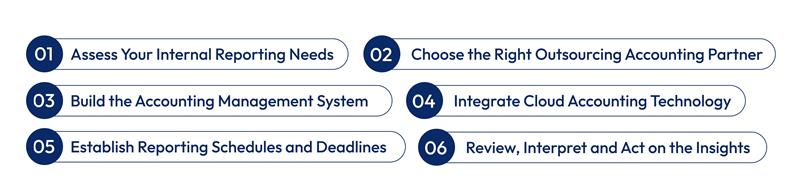
Step 1: Assess Your Internal Reporting Needs
Every successful outsourcing engagement begins with an honest look inward. Before approaching any provider, businesses need to understand exactly where their reporting function is falling short.
Ask the right questions:
- Which management reports are missing, delayed, or inaccurate?
- Which business decisions are being made without adequate financial data?
- How frequently does leadership need financial visibility to act with confidence?
What to document at this stage:
| Area to Review | What to Look For |
|---|---|
| Current reporting output | What reports exist and how often they are produced |
| Reporting turnaround | How long after month end reports are delivered |
| Decision-making gaps | Where financial data is absent or unreliable |
| Future reporting needs | What the business will need as it grows |
This assessment becomes the brief for your outsourcing engagement. The clearer it is, the faster your provider can deliver value.
Step 2: Choose the Right Outsourcing Accounting Partner
Choosing the right provider is the most consequential decision in the entire process. The difference between a transactional vendor and a genuine finance partner is significant and it shows up in the quality of reporting from month one.
Look for outsourcing accounting firms that offer:
- Proven experience in management accounting consulting services
- Familiarity with Australian business environments
- A clearly defined service scope with no ambiguity over inclusions
- Transparent outsourced accounting pricing across all service tiers
- Dedicated support rather than a generic account management model
The right partner will ask questions about your business goals, not just your chart of accounts. That is the clearest signal that they are approaching the engagement as a finance partner.
Step 3: Build the Accounting Management System
Once a provider is confirmed, the engagement needs a proper operational foundation before reporting can begin. This stage is frequently underestimated, yet it determines the quality and consistency of every deliverable that follows.
Key decisions at this stage include:
- Agreeing on a chart of accounts that reflects how the business actually operates
- Establishing report templates and delivery formats
- Defining data access protocols between the business and the outsourcing team
- Documenting who is responsible for what at each stage of the monthly cycle
Getting this right early eliminates the most common causes of reporting delays and miscommunication down the line.
Step 4: Integrate Cloud Accounting Technology
Modern outsourcing management accounting services runs entirely on cloud platforms. Accounting and management tools and technology ensures both the business and the outsourcing team always work from the same live data, removing the delays and errors that come with manual file handling.
Most widely used platforms in Australia:
| Platform | Best Suited For |
|---|---|
| Xero | SMEs wanting real-time reporting and automation |
| MYOB Advanced | Businesses with more complex operational structures |
| QuickBooks Online | Flexible, widely supported across industries |
Beyond the core platform, providers also integrate reporting tools such as Fathom or Spotlight Reporting for visual KPI dashboards and automation layers that connect accounting data with payroll, CRM and inventory systems.
Step 5: Establish Reporting Schedules and Deadlines
Consistency is the foundation of useful outsourced management reporting. Without firm, agreed deadlines, reporting drifts and the value of the engagement erodes quickly.
Set clear timelines for:
- Monthly management accounts delivery
- Rolling forecast updates
- Budget review meetings
- Cash flow reporting cycles
- KPI dashboard refreshes
Build every deadline into a shared calendar and treat them as non-negotiable commitments. Reporting that arrives on a predictable schedule becomes a reliable input into business decisions. Reporting that arrives whenever it is ready does not.
Step 6: Review, Interpret and Act on the Insights
Receiving management reports is not the same as using them. The final step is the one most often treated as an afterthought, yet it is where the real value of management accounting outsourcing is realised.
Schedule regular review meetings with your outsourcing team to:
- Work through results and identify trends
- Discuss variances and understand the reasons behind them
- Update forecasts based on current trading conditions
- Surface risks or opportunities that require management attention
Over time, as the provider builds a deeper understanding of the business, these conversations shift from reporting on what happened to advising on what to do next.
That transition marks the point at which outsourcing management accounting delivers its full value.
What Services are Included in Management Accounting Outsourcing?
A well-structured engagement covers the full internal reporting function. For businesses exploring how to outsource management accounting effectively, the core services most businesses require are outlined below.
| Service | What It Delivers |
|---|---|
| Management Accounts Preparation | Monthly P&L, balance sheet and cash flow reports |
| Budgeting Forecasting Outsourcing | Annual budgets, rolling forecasts and projection updates |
| Variance Analysis | Actuals vs budget comparison with management commentary |
| KPI Tracking and Dashboards | Real-time performance metrics updated automatically |
| Cash Flow Reporting | Ongoing liquidity monitoring and shortfall alerts |
Each service plays a distinct role in giving leadership the visibility needed to make confident, timely decisions. Together they form a complete accounting management solution for growing businesses.
Benefits of Outsourcing Management Accounting
The benefits of outsourcing management accounting go well beyond cost savings. For management accounting for SMEs specifically, the impact is felt across reporting quality, decision-making speed and overall financial discipline.
- Cost efficiency: No salary, no superannuation, no recruitment overhead. Senior-level financial capability at a predictable monthly cost through accounts outsourcing services.
For small and growing businesses, this alone makes outsourcing in accounting one of the most impactful operational decisions available. - Specialist expertise: Outsourced account management brings focused experience that a single in-house hire rarely matches. The team’s entire professional focus is management accounting and that depth is consistent across every engagement.
- On-time reporting: Providers of accounting outsourcing services operate to contractual deadlines. Reports arrive when they are supposed to, every month, without chasing.
- Better decisions: Consistent, structured reporting gives leadership the financial clarity to plan, invest and grow with confidence. The value is not in the reports themselves, but in what they make possible.
In-House vs Outsourced Accounting: How Do They Compare?
For businesses weighing up whether to build internally or outsource, the table below covers the factors that matter most in making that decision.
| Factor | In-House Accounting | Outsourced Accounting |
|---|---|---|
| Cost | High, salary, super, overheads | Predictable monthly fee |
| Expertise | Dependent on the individual hired | Specialist team with dedicated focus |
| Scalability | Constrained by headcount | Scales with business needs |
| Reporting Speed | Frequently delayed | Delivered to agreed schedule |
| Flexibility | Limited, tied to employment terms | Easily adjusted as requirements change |
For most Australian SMEs, the outsourcing model delivers better outcomes at lower cost, particularly in the growth phase when reporting needs are increasing but the business is not yet at the scale to justify a full finance team.
Conclusion
The businesses that make the best decisions are not the ones with the most data. They are the ones with the right data, delivered on time, in a format leadership can actually use. That is what outsourcing management accounting services are built to provide.
Outbooks supports Australian SMEs with structured management reporting, experienced accounting professionals and cloud-based systems that deliver reliable insights. With flexible service models and transparent pricing, businesses gain dependable reporting support without the need to build a full in-house team.
Ready to improve your financial visibility with reliable management accounting support? Reach out to the Outbooks team at info@outbooks.com.au or call 0451 320 102 today.
FAQs

Parul is a content specialist with expertise in accounting industry. Her writing covers a wide range of domains such as, Accounts Payable, Accounts Receivables, Bookkeeping and more. She writes well-researched content and has a strong understanding of accounting terms and industry-specific terminologies. As a subject matter expert, she simplifies complex concepts into clear, practical insights, helping businesses with accurate tips and solutions to make informed decisions.