



In Australia, businesses are struggling to find enough skilled accounting professionals locally, while also needing faster and more reliable support with their finances. Offshoring accounting has become a practical answer to these problems, letting firms bring in professional offshore accountants and bookkeepers from other countries to join their teams.
By offshoring accounting work through trusted outsourced accounting companies, Australian businesses are able to deliver better service, be more productive and build stronger operations without sacrificing quality. This guide will explain why offshoring matters now, how it actually works and what benefits it brings beyond simply saving money.
In this blog, we’ll discuss:
- Key Australian market data (2026 Statistics)
- The main reasons behind the increasing use of offshore accounting services in Australia.
- Advantages like finding specialist staff, working more efficiently and growing your business.
- Typical accounting tasks commonly offshored for optimal results.
- How to pick the right offshore accounting provider?
Key Australian market data (2026 Statistics)
- KPMG’s Keeping Us Up at Night 2026 survey shows technology, especially AI, has become the number one concern and priority for Australian business leaders, with digital transformation remaining high on the agenda.
- Around 97% of Australian businesses continue to be small businesses, with millions of SMEs actively trading and employing a significant share of the national workforce, reinforcing their central role in the economy.
- A Deloitte Access Economics report (Nov 2025) shows that around two-thirds of Australian SMBs are already using AI, indicating strong and growing adoption as part of digital strategies.
- Government AI adoption tracking shows larger SMEs (20–199 employees) with ~68% AI use, while smaller segments are rapidly increasing adoption as part of digital transformation efforts.
- Offshore accounting and digital tools are now central to Australian business adaptation, enabling firms to thrive amid rapid market changes and persistent cost pressures.
What is Offshoring Accounting?
Offshoring accounting is an operational strategy where a business hires qualified accounting professionals located in another country to handle its financial or accounting functions.
Rather than working with a local brick-and-mortar firm or hiring an in-house employee, you build or plug into a remote team based in a global talent hub (such as India or the Philippines). These professionals manage your day-to-day ledger, payroll, or accounts management just like an internal department would, they just happen to do it from a different zip code.
Why are more Australian Businesses choosing Offshore Accounting?
Australian firms are under pressure from growing workloads and the difficulty of finding qualified accounting professionals locally. Offshoring accounting has gained popularity because it helps solve these challenges and supports business growth in several ways.
1. Addressing talent shortages
Offshoring provides access to qualified accountants and bookkeepers from countries with strong accounting training, helping firms clear backlogs and maintain steady delivery without long local recruitment processes.
In today’s world finding skilled professionals is a tough task. According to the Finance Industry Report Australia will face a shortfall of around 25,000 workers by 2030. Accounting will be worst hit, 21% of staff will leave, mostly because 29% are over 50 and retiring.
With few skilled workers available, businesses compete for talent. This increases the wages and cost, reducing profits and making team growth difficult.
2. Access to specialist skills
You can build teams with professionals who specialise in specific areas (such as invoicing, payroll or financial reporting) and work to Australian standards, ensuring accurate and reliable results from the start.
Hybrid work is now standard in Australian companies, making it easy to add outsourced accountant teams with local staff. As of 2025, around 70% of Australian companies now operate hybrid, according to the AHRI Hybrid and Flexible Working Report 2025, making it easier to add offshore accountants to your team.
This makes collaboration easier across borders and allows businesses to make better use of remote accounting services.
3. Secure collaboration
Cloud-based software like Xero, MYOB and QuickBooks allows your offshore team to access systems securely and communicate in real-time, making them part of your regular operations.
4. Managing staff for busy periods
You can increase your team during busy periods (such as end of financial year) and reduce it when demand is lower, so you only pay for the staff you actually need.
5. Work faster with clear pricing
Teams working across different time zones mean work continues overnight, speeding up completion times. Fixed pricing makes budgeting straightforward and reliable.
6. More time for high-value client services
With routine tasks handled offshore, your local team can focus on advisory work, strategic planning and services that generate more revenue and add greater value to clients.
7. Improved compliance and quality assurance
Documented procedures, dual review processes, controlled system access and clear service standards support regulatory compliance, audit readiness and consistent quality across all work.
8. Technological advancement
Offshore providers leverage advanced automation and cloud-based platforms, which streamline processes, enhance accuracy and enable real-time access to financial data. This technological edge increases efficiency and provides Australian businesses with better insights for strategic decision-making, further empowering their shift towards offshore solutions.
These approaches work particularly well for small and medium businesses who have limited budgets to hire several full-time accountants locally but still need reliable professional support to keep their finances running smoothly.
Benefits of Offshore Accounting Services
While cost considerations often motivate companies to explore offshore options, the strategic benefits go far beyond saving money. Offshore accounting provides operational advantages that strengthen an Australian business’s ability to compete and grow sustainably.
Some key benefits include:
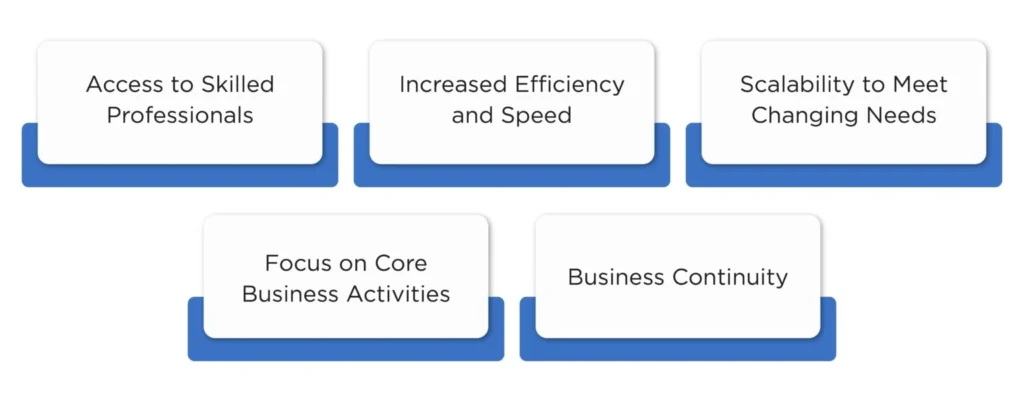
- Access to skilled professionals: Many global talent hubs offer large pools of qualified accounting graduates and experienced bookkeepers who can handle complex or routine tasks effectively.
- Increased efficiency and speed: Distributed teams can work during Australian off-hours, delivering completed tasks by the start of the local business day, reducing turnaround times.
- Scalability to meet changing needs: You can adjust your extended team size based on current workload demands. This provides the flexibility to scale up during peak periods or reduce capacity during quieter times without the usual hiring processes.
- Focus on core business activities: By delegating routine bookkeeping and data entry tasks to a remote team, your Australian-based accountants can dedicate more time to advisory services and strategic work that directly benefits clients.
- Business continuity: This model offers stability and continuity by ensuring work is not disrupted by local staff absences or turnover.
- Quality assurance and compliance: Remote specialists follow clear SOPs, maker–checker reviews and SLAs to ensure accuracy, audit readiness and adherence to Australian accounting standards.
- Technology integration: Cloud tools like Xero, MYOB and QuickBooks enable secure, real-time collaboration and role-based access between onshore and external teams.
- Cost predictability: Fixed or transparent pricing models make budgeting easier and protect firms from unexpected overheads.
- Role-specific expertise: Outsourced professionals focus on AP/AR, payroll, reconciliations and reporting, improving accuracy and delivery quality.
- Time zone advantage: The “follow-the-sun” workflow allows continuous progress after Australian hours, reducing turnaround times and boosting efficiency.
Common services handled by Offshore Accountants
Bookkeeping
Bookkeepers record your daily transactions, reconcile bank accounts and update ledgers. They know how to use Xero, MYOB and other Australian accounting software
Accounts Payable
Managing supplier invoices, verifying payments, tracking due dates and ensuring vendors are paid accurately and on time.
Accounts Receivable
Creating and sending customer invoices, monitoring outstanding payments and maintaining consistent cash inflow through timely collections.
Payroll Processing
Calculating wages, managing deductions and preparing payroll reports integrated with Australian payroll platforms. These connect with Australian payroll systems and help reduce errors.
Data Entry & Filing
Organising financial records, entering data into accounting systems and maintaining up-to-date documentation.
Report Preparation
Drafting financial summaries and reports to help local accountants meet compliance and client deadlines.
Management Reporting & Analysis
Producing cash flow reports, expense summaries and profitability insights for better business decisions.
Financial Statement Drafting
Assisting with initial preparation of financial statements to speed up the month-end and year-end close processes.
Accounts clean-up and data migration
Streamlining old records and migrating accounting information into modern cloud-based systems.
These services help you run your back-office work more smoothly and keep your business’s records accurate and current without needing to hire more local staff.
How Offshore Accountants work with Australian Businesses?
Through modern technology and systematic processes, this accounting model provides greater closeness and efficiency than you might expect. The system completely eliminates the geographical differences.
Tools used:
Your accounting team uses the same cloud based accounting and bookkeeping software that is well-known in the Australian market. Xero, MYOB, QuickBooks Online are perfect for this. Your outsourced accountant can view your data instantly so everyone has the same information.
Beyond that they use:
- For communication: Slack, Teams and Zoom for messages and video meetings.
- To track work: Trello or Asana shows what’s done and what’s left.
- Data security: Everything is encrypted so your information is safe.
Flexible, Secure and Scalable Accounting Partnerships
Regular reporting and real-time dashboards allow Australian business owners to monitor progress and make informed decisions, bridging any gaps in time zones or processes.
Many outsourcing providers offer scalable support, letting you increase or decrease your team as business needs change, providing flexibility and cost savings. This ensures that your accountants and bookkeepers are not just remote helpers, but integral, secure and efficient partners in your business’s growth.
Example of Daily Work
Imagine a bookkeeper starts his or her Day by processing all your bills, reconciling accounts and finishing the daily work. When you arrive at the office, half of your work is already completed. This “follow the sun” approach to bookkeeping services keeps your business running 24 hours a day.
How to choose the right Offshore Accounting Provider?
Choosing the correct offshore accounting partner is important for success. Beyond cost, Australian firms should prioritise providers with experience meeting local business expectations and familiarity with commonly used accounting platforms.
Consider these factors when selecting a provider:
- Experience working with Australian businesses and knowledge of how Australian accounting works
- Ability to use your accounting software like Xero, MYOB or QuickBooks Online
- Good communication including regular updates and someone you can contact when needed
- Proper security measures to protect your data and systems that work with yours
- Ability to increase or decrease team size as your workload changes
- Track record of compliance with data privacy and confidentiality standards such as ISO 27001 or GDPR.
- Clear service-level agreements (SLAs) outlining turnaround times, accuracy levels and escalation protocols.
- Transparent pricing structure with no hidden fees, ensuring predictable budgeting.
- Proven onboarding process that includes training, communication setup and integration with your existing workflow.
- References or case studies from other Australian clients that demonstrate reliability and performance.
Choosing your provider carefully means the relationship works well and you get the most from offshoring accounting.
What to look for in Offshore Accounting providers?
Choosing the right partner is the most important decision. Australian businesses should focus on providers who demonstrate:
- Experience: Companies should have a good understanding of Australia’s business practices.
- Security: They should have strong security measures in place.
- Support: Look for companies that have a solid communication plan and positive reviews from other Australia’s customers.
- Technology and Integration: Use of popular cloud accounting software used in Australia like Xero, MYOB and QuickBooks Online.
Practical examples
This isn’t just an idea; it’s a proven model.
- Experience: CPA Australia found that over 11% of accounting firms now use offshore teams for basic tasks like bookkeeping and audit preparation. These firms save money and free up local staff to focus on client advice and higher-value work.
- Security: For auditing, over 45% of major Australian companies use offshore teams for paperwork, reconciliations and data processing, as noted in the same CPA Australia report. This lets senior staff spend more time on strategy and client work instead of repetitive tasks.
The main benefits are cost savings, faster completion of routine work and allowing local teams to focus on growth and client relationships.
KPIs to measure
To ensure offshore accounting partnerships deliver expected benefits, Australian companies should track specific Key Performance Indicators (KPIs). These metrics demonstrate how well offshore accountants align with the company’s objectives and operational standards.
Important KPIs include:
- Turnaround time: How quickly routine and urgent accounting tasks are completed.
- Accuracy: Error rates in bookkeeping, reconciliations and data entry.
- Cost efficiency: Comparing offshore service costs against local alternatives while measuring value delivered.
- Client satisfaction: Feedback from internal teams and clients served by the offshore team.
- Scalability: Ability to scale the offshore team size up or down smoothly based on workload demands.
Regular review of these KPIs allows firms to adjust processes or providers to ensure smooth operations.
The Future Outlook
The challenge of working globally is getting stronger.
- AI and automation: As technology improves and basic data entry work will be done by machines. This will allow your offshore accountants to provide more detailed analysis and advice, just like business consultants. (check our blog: Future of Accounting AI in Australia)
- The Hybrid model: In the future, local and offshore employees will work together, giving you both a local presence and a strong, skilled global team.
In simple words,
- With the help of technology machines will do the minor accounting tasks.
- Offshore accountants will get more important and consultative jobs.
- Companies will employ a mix of employees both in Australia and abroad to work together.
Your Trusted Outsourced Accounting Partner.
Get Started TodayConclusion
Offshore accounting has become essential for Australian businesses seeking sustainable growth amid talent shortages and increasing operational demands. By leveraging skilled offshore accountants and bookkeepers, firms enhance efficiency, flexibility and service quality while maintaining control through integrated cloud tools and clear communication.
With the right offshore partner, Australian businesses can focus on strategic priorities and client success, making offshore accounting not just a cost-saving strategy but a necessary evolution in modern accounting practice.
Have questions or want to get started? Email info@outbooks.com.au or call 0451320102.
FAQs

Parul is a content specialist with expertise in accounting industry. Her writing covers a wide range of domains such as, Accounts Payable, Accounts Receivables, Bookkeeping and more. She writes well-researched content and has a strong understanding of accounting terms and industry-specific terminologies. As a subject matter expert, she simplifies complex concepts into clear, practical insights, helping businesses with accurate tips and solutions to make informed decisions.