Monthly accounts play an important role in how Australian SMEs review their business performance. They show what the business has earned, spent and received during the month. However, these figures need to be checked against the accounting records before they can be used to assess results or make business decisions.
The month-end close process brings this work together. It involves reviewing recorded transactions, reconciling bank and other account balances, checking outstanding income and expenses, and correcting discrepancies before the accounts are finalised. Each task helps ensure that the monthly reports reflect the financial activity of the period being reviewed.
For Australian SME owners, bookkeepers and finance teams, this guide explains how to carry out the month-end close, which records and checks are involved, how to organise responsibilities and timelines, and what financial reports to prepare at the end of the month.
Key takeaways
- A consistent month-end close checklist helps businesses complete the same accounting checks every month.
- Bank, supplier, customer and payroll records should be checked before month-end adjustments are reviewed and posted.
- Supporting documents are important for reviewing balance sheet accounts and identifying unexplained figures.
- Monthly figures should be reviewed by someone other than the person who prepared the records.
- A completed close should include supporting schedules, financial reports and a record of any outstanding differences.
What should be ready before the month-end close?
Before the closing work begins, the business needs an agreed cutoff date, a schedule of accounting tasks and the documents required to check its records. These preparations help the bookkeeper understand which transactions belong to the month and which information is still outstanding.
Set a cutoff date and prepare a close calendar
A cutoff date establishes the final date for recording transactions in the month being reviewed. The business should also decide how to account for transactions relating to the closing month when their invoices or supporting documents arrive later. This helps ensure that income and expenses are recorded in the appropriate accounting period.
The business should agree on how late invoices, expense claims and approvals will be handled. This prevents expenses from being missed simply because the supporting document arrives after the month ends.
A close calendar can then assign each activity to a responsible person and give it a completion date. It does not need to be complicated. A shared spreadsheet can cover the following details:
- Accounting task to be completed.
- Person responsible for the task.
- Date by which the work should be finished.
- Status of the task and any pending information.
Employees who submit expense claims and managers who approve supplier bills should also know the cutoff date. Their timely submissions help the accounts team complete the monthly records.
Collect supplier bills, expense claims and account statements
Once the cutoff date and work schedule are agreed, the next step is to collect the financial records needed for the month-end review. These records help the bookkeeper check whether all income, expenses, payments and adjustments relating to the month have been accounted for.
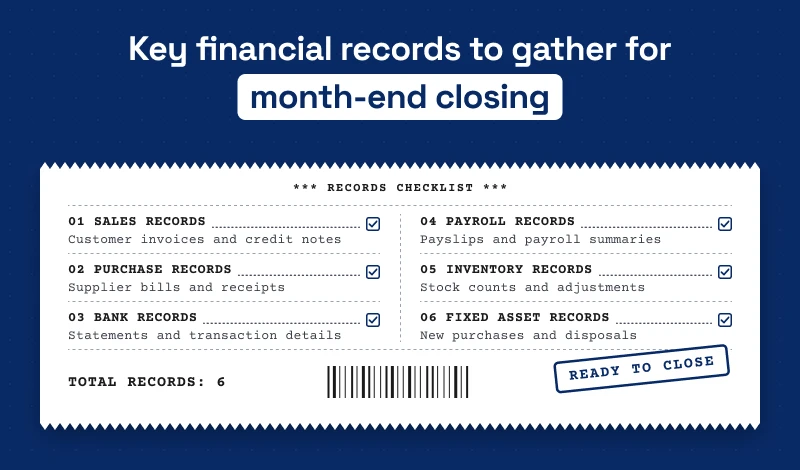
The six categories provide a starting point for collecting the records required for the month-end close. However, some businesses may need additional documents depending on their transactions and accounting arrangements.
| Additional documents | What they help verify |
|---|---|
| Staff expense claims and receipts | Business expenses and employee reimbursements |
| Loan and lease statements | Outstanding amounts, repayments and interest charges |
| Payment platform reports | Sales receipts, processing fees and pending payouts |
Payment platforms can also create differences between sales recorded and cash received. A business using Stripe, for instance, may receive customer payments throughout June, while some payouts reach its bank account in July. The Stripe payout report helps the bookkeeper identify the transactions belonging to June and check whether the outstanding amount has been recorded correctly.
Document capture tools such as Dext and Hubdoc can also help collect supplier invoices and receipts throughout the month. They reduce the need to request the same documents again when the monthly review begins.
What are the main steps in a month-end accounting close?
The activities involved in a month-end accounting close depend on the size of the business, the number of transactions and the accounting records it maintains. However, most SMEs need to complete transaction recording, account reconciliations, payroll checks, journal adjustments and financial reviews before preparing their final reports.
The following sequence provides a practical way to organise these activities. Some tasks can overlap, while others need to be completed first so that the next review uses updated figures.
Record and code every transaction
The first task is to make sure that all sales, supplier bills, customer receipts, expenses and bank transactions for the month are recorded in the accounting software.
The bookkeeper should check that:
- All sales and purchase invoices have been entered.
- Bank feeds include transactions up to the final day of the month.
- Receipts and expense claims have been recorded.
- Transactions are assigned to the correct general ledger accounts.
- Duplicate entries and uncategorised transactions have been reviewed.
Correct account coding is important because the profit and loss and balance sheet reports use these entries to present the business’s financial position.
The bookkeeper should also review how purchases have been classified. Items that meet the business’s asset recognition criteria may need to be recorded as fixed assets rather than ordinary expenses. The appropriate treatment should follow the business’s accounting policies and be reflected consistently in the general ledger.
A suitable chart of accounts also makes transaction coding easier. The account categories should reflect the business’s actual income, expenses, assets and liabilities.
Complete bank and credit card reconciliation
Once the transactions have been recorded, the next task is to compare the accounting records with the corresponding bank and credit card statements. This is known as bank reconciliation and credit card reconciliation.
Each account should be checked against its closing balance on the final day of the month. Any difference needs to be investigated rather than carried forward without an explanation.
Common differences include:
- Bank charges that have not been recorded.
- Customer payments missing from the accounting records.
- Duplicate transactions.
- Payments recorded in the wrong period.
- Transactions that have not yet cleared the bank.
The review should distinguish genuine errors from timing differences, such as transactions recorded in the accounting software that have not yet appeared on the bank statement. Only confirmed errors should result in correction entries.
Payment platform accounts also need attention. The amounts recorded as pending payouts should be compared with the platform’s reports, with processing fees and other adjustments accounted for before the balance is accepted.
Reconcile accounts payable and accounts receivable
Bank reconciliation alone does not confirm that all supplier bills and customer payments have been recorded correctly. The accounts payable and accounts receivable balances also need to be checked against their supporting records.
Accounts payable reconciliation
The accounts payable ledger should agree with the total outstanding supplier bills. Supplier statements can help identify invoices that are missing, payments that have not been allocated and bills that may have been recorded more than once.
A plumbing business reviewing its main supplier’s June statement may find an invoice for $4,180 dated 27 June that is not included in its accounting software. The bookkeeper should check the invoice, confirm that the work or materials relate to June and record the missing amount in the correct period.
Accounts receivable reconciliation
The accounts receivable balance should agree with the outstanding customer invoices in the aged receivables report. Payments and credit notes should also be matched with the correct invoices.
A customer payment recorded against the wrong invoice can make an account appear overdue even when the customer has already paid. Reviewing these entries helps the business maintain accurate customer balances and identify amounts that need follow-up.
Reconcile payroll with the general ledger
The payroll summary for each pay run in the month should agree with what was posted to the ledger. Gross wages in the payroll report should equal the wages expense recorded, and the net pay released should match the payments leaving the bank account. Leave balances in the payroll system should also match the leave liability in the ledger, since a gap there changes both profit and the balance sheet.
Payroll reconciliation is worth doing properly because errors reach employees directly. A pay slip that is late or missing required details can attract fines, according to the pay slip requirements on business.gov.au, so differences found at this step are best corrected at source.
Post accruals, prepayments and month-end journal entries
After the main account reconciliations, the bookkeeper can review expenses and income that need to be recorded in the correct month. Accruals and prepayments are important here because the date of an invoice or payment does not always match the period in which the expense or income belongs.
For businesses preparing accrual-based financial reports, income and expenses should be recognised in the period to which they relate, rather than solely according to when cash is received or paid.
Accruals
An accrual records an expense or income in the period it relates to, even when the invoice or payment is received later.
Suppose a business receives a $6,000 repair invoice on 8 July for work completed in June. Since the work relates to June, the expense should be included in June’s records. A $6,000 accrual can be recorded in June and reversed in July when the actual invoice is entered, subject to the business’s accounting treatment.
Prepayments
A prepayment applies when a business pays for a service or expense that covers several months.
An annual insurance premium of $12,000 paid on 1 June covers twelve months. Therefore, $1,000 is recorded as an expense for June. The remaining $11,000 is recorded as a prepayment and recognised as an expense over the following months.
Other recurring adjustments may include:
- Monthly depreciation on fixed assets.
- Rent and insurance expenses.
- Interest on loans.
- Accrued expenses for services already received.
- Income earned but not yet invoiced, where applicable.
Every month-end journal entry should have a supporting calculation, explanation or document attached. This allows the reviewer to understand why the adjustment was made and how the amount was calculated.
Review the general ledger and balance sheet accounts
Once the reconciliations and adjustments are complete, the general ledger needs a final review. The purpose is to identify entries that may have been recorded in the wrong account, incorrect reporting period or an unexpected amount.
The review can include:
- Unusually large or round-number transactions.
- Personal expenses recorded as business expenses.
- Entries posted to the wrong month.
- Unallocated payments and receipts.
- Unexpected debit or credit balances.
- Unexplained amounts in suspense accounts.
Balance sheet accounts also need supporting evidence. Each material balance should be supported by a reconciliation, schedule, statement or other relevant record. A balance should not be treated as verified simply because it appears in the accounting software.
The following table shows the documents that can support the main balance sheet accounts.
| Account | Supporting evidence | What the reviewer should confirm |
|---|---|---|
| Bank and credit cards | Bank and card statements | Closing balances agree or differences are explained |
| Loans and leases | Lender statements and repayment schedules | Outstanding amounts and repayments are recorded correctly |
| Fixed assets | Asset register and depreciation schedule | Asset balances and depreciation entries agree |
| Prepayments and accruals | Supporting invoices and calculation schedules | Each outstanding amount has a valid explanation |
| Accounts payable | Supplier statements and aged payables report | Outstanding supplier balances agree |
| Accounts receivable | Customer records and aged receivables report | Outstanding invoices and payments are correctly allocated |
| Payroll liabilities | Payroll summaries and supporting schedules | Recorded payroll-related balances agree |
| Suspense accounts | Transaction details and supporting documents | Unidentified entries are investigated and cleared where possible |
Any unexplained balance should be investigated and documented. If it cannot be resolved before reporting, its nature and potential effect on the financial statements should be recorded for review rather than treating the account as fully reconciled.
Review profit and loss movements through variance analysis
With the ledger and balance sheet reviewed, the profit and loss report can be examined to understand changes in business income and expenses.
Financial variance analysis compares the current month’s results with previous periods or the budget. The aim is to identify significant movements and understand the reasons behind them.
For a small business, the review can include:
- Comparing income and expenses with the previous month.
- Checking results against the same month in the previous year.
- Comparing actual figures with the monthly budget.
- Investigating significant increases or decreases in individual expense categories.
- Adding short explanations for movements that need attention.
Variances should be assessed in the context of the business’s activity, transaction volume and accounting records. A movement should not automatically be treated as an error; the reviewer should establish whether it reflects normal business activity, a timing difference or an incorrect entry.
The reviewer can prepare a short explanation for each significant movement so the owner understands what changed without having to examine individual ledger entries.
Check cash flow and close the accounting period
The final review should cover the business’s cash position and any outstanding items before the monthly reports are prepared.
The cash flow report should be checked against the reconciled bank balances. The business should also review expected customer receipts, upcoming supplier payments and other financial commitments to understand whether sufficient cash will be available to meet its obligations.
Once the figures have been reviewed and approved, the accounting period can be locked in the software. This helps prevent unauthorised changes to transactions recorded in the completed period.
Xero, for instance, allows businesses to set a lock date that restricts users from adding or changing transactions dated on or before that date. QuickBooks Online also provides a closing books feature to restrict changes to completed periods.
However, locking an accounting period does not confirm that all figures are accurate. The reports should only be approved after the relevant reconciliations, journal entries and balance sheet checks have been completed. If a correction is required after closing, it should be authorised and documented. Any reports affected by the change should also be reviewed and updated where necessary.
The supporting reconciliations, journal entries, schedules and financial reports should be saved together for future reference.
For record retention, the seven-year requirement applies to companies covered by the financial record-keeping rules under the Corporations Act 2001. It should not be presented as a blanket requirement for every Australian SME.
How long should a month-end close take?
For an SME with up-to-date bookkeeping and a manageable number of transactions, five working days can be a reasonable target for completing the month-end close. However, the actual time depends on the volume of transactions, number of accounts, availability of supporting documents and complexity of the business.
A business that maintains several bank accounts, manages inventory or operates through multiple locations may need additional time. On the other hand, businesses that complete reconciliations throughout the month may finish their closing work sooner.
A five-day month-end close checklist
The following schedule shows how a small business can distribute the main activities across five working days.
| Working day | Tasks | Responsible person | Completion point |
|---|---|---|---|
| Day 1 | Check the cutoff, enter outstanding invoices and expenses, import bank transactions and complete coding | Bookkeeper | Transactions are recorded and coded |
| Day 2 | Complete bank, credit card and payment platform reconciliations; review supplier and customer balances | Bookkeeper | Account differences are identified and investigated |
| Day 3 | Complete payroll reconciliation and post accruals, prepayments and depreciation entries | Bookkeeper | Adjustments are recorded with supporting documents |
| Day 4 | Review the general ledger and balance sheet accounts; investigate unexplained balances | Accountant or reviewer | Account balances have been checked and supported |
| Day 5 | Complete variance analysis, review cash flow, obtain approval and close the period | Owner or finance lead | Final reports are approved and the period is closed |
This is a suggested month-end close checklist, not a fixed deadline. Businesses should adjust the schedule according to their transaction volume, reporting requirements and the availability of supporting information.
What can delay the month-end close?
Even when a business follows a regular closing schedule, certain accounting issues can increase the time required to complete it. Identifying these problems helps the accounts team improve the next month’s routine.
Some common causes include:
- Late supplier invoices and expense claims: When employees submit receipts or supplier invoices several days after the cutoff, the bookkeeper may need to revisit entries and update reconciliations. Setting an internal submission deadline helps reduce these delays.
- Transactions recorded only at month end: If sales, expenses and bank transactions are entered once a month, the bookkeeper has to process a large volume of information before the reconciliations can begin. Recording transactions throughout the month makes the closing work easier to manage.
- Unresolved differences in clearing accounts: Payment platform balances, unidentified bank transactions and suspense account entries can remain unresolved for several months. Reviewing these balances regularly prevents the same differences from appearing in every monthly close.
- Delays in approvals and supporting information: A missing approval for a supplier invoice or an unexplained payment can hold up the review. Assigning responsibility for each pending item helps the team follow up with the right person.
Businesses can monitor two useful measures to understand whether their month-end close is improving:
- Time taken to complete the close: The number of working days between the month ending and the final report approval.
- Changes made after closing: The number of corrections or adjustments required after the period has been closed.
A reduction in both measures over time can indicate that the accounting records and review process are becoming more consistent.
Who is responsible for the month-end close in a small business?
The month-end close usually involves three responsibilities: preparing the accounting records, reviewing the work and approving the final reports. In a small business, one person may handle more than one responsibility, depending on the available staff and the volume of accounting work.
| Role | Usually handled by | Main responsibilities |
|---|---|---|
| Preparer | Bookkeeper or accounts staff | Recording transactions, reconciliations, journal entries and draft reports |
| Reviewer | Accountant, finance manager or senior accounts professional | Checking account balances, supporting documents, adjustments and significant movements |
| Approver | Business owner, director or finance lead | Reviewing financial results, approving reports and authorising the period close |
In a small business, an in-house bookkeeper may record transactions and prepare the monthly reports, while an external accountant reviews the reconciliations and balance sheet before the owner approves the final figures.
Separating preparation and review responsibilities helps another person identify errors that may have been missed during the initial accounting work.
What should a business receive once the month is closed?
A closed month should produce a profit and loss report, a balance sheet, a cash flow report and a short note on the main movements. Because they come from a locked ledger, each can be read as final.
- The profit and loss shows income, costs and the resulting profit for the month, compared with earlier periods.
- The balance sheet shows what the business owns, owes and holds in equity on the last day of the month.
- The cash flow report shows where cash came from and where it went, which can differ sharply from profit when customers pay late.
Businesses that require more detailed financial information can also receive monthly management accounts. These may include budget comparisons, financial ratios, performance summaries and commentary on significant changes.
How can Australian SMEs make the month-end close faster without losing accuracy?
A faster close does not mean reducing the number of accounting checks. It means completing routine work throughout the month so fewer transactions and documents remain outstanding when the reporting period ends.
The following practices can help:
- Reconcile accounts every week: A café with three bank accounts can check each account every Monday rather than waiting until the end of the month. Missing deposits and duplicate entries are easier to identify when transactions are reviewed regularly.
- Record bills and receipts when received: Capturing supplier invoices and expense receipts throughout the month reduces the number of documents that need to be collected during the closing week.
- Use recurring journal entries: Regular expenses such as rent, insurance and depreciation can follow a monthly schedule, with the supporting calculations available for review.
- Keep supplier and customer balances updated: Recording invoices, payments and credit notes as they occur helps maintain accurate accounts payable and receivable records.
- Review delays after each close: Note which activities took longer than expected and make one or two practical changes before the next month begins.
Businesses whose bookkeeping is several months behind may need to complete catch-up bookkeeping before introducing a regular monthly close. This gives the accounts team a complete set of records to work with.
How does Outbooks support the month-end close?
Outbooks provides bookkeeping support for Australian businesses, including transaction recording, bank and credit card reconciliations, accounts payable and receivable records, and monthly financial reporting. These activities can help businesses maintain organised accounting records and prepare information for their month-end review.
The work is completed within the business’s existing accounting software, including Xero, MYOB and QuickBooks. This allows businesses to receive accounting support without having to change their current software setup.
Depending on the agreed requirements, monthly reporting can include:
- Profit and loss statements.
- Balance sheets.
- Cash flow reports.
- Aged receivables and payables summaries.
- Budget versus actual comparisons.
Businesses can also choose the processing frequency that suits their accounting requirements, whether daily, weekly or monthly. For organisations that need more detailed financial analysis, Outbooks also provides management accounts services.
This support allows business owners and finance teams to spend less time on recurring bookkeeping activities while retaining oversight of their financial records.
Conclusion
A reliable month-end close depends on complete records, regular reconciliations, supported adjustments and a final review before the reports are issued. When these activities follow a consistent schedule, Australian SMEs can identify accounting errors earlier and receive financial information they can use to make business decisions.
The process does not need to be complicated. A suitable checklist, clearly assigned responsibilities and regular bookkeeping can make monthly reporting easier to manage as the business grows.
To discuss what that would involve, contact the Outbooks team or email us at info@outbooks.com.au .
Frequently asked questions
Can a closed month be reopened if a mistake is found?
Yes, a closed month can be reopened by changing or removing the applicable lock date in the accounting software, subject to the user’s access permissions. The incorrect entry can then be corrected, and the period can be closed again. Any reports already issued should also be checked and updated if the correction changes the reported figures.
What should happen to a supplier bill received after the books are closed?
The business should first check which period the expense relates to. If the bill relates to the previous month and the amount is material, an adjustment may be required in that period. If it relates to the current month, it should be recorded in the current month’s accounts. The treatment should follow the business’s accounting policies.
Is closing the books quarterly enough for a small business?
The frequency of a formal accounting period close depends on the business’s reporting needs and the information required to make decisions. Monthly closing provides more regular visibility of income, expenses and cash flow, while some low-volume businesses may choose less frequent formal reporting reviews. However, keeping transaction records current and reviewing account balances regularly remains important.
Which month-end close tasks can be handled by an external bookkeeper?
An external bookkeeper can assist with transaction recording, bank and credit card reconciliations, accounts payable and receivable processing, payroll processing and preparation of monthly reports. The business owner or finance lead can retain responsibility for reviewing the results, approving adjustments and making business decisions.
What does a business with one bank account and few transactions need to do?
A business with a small number of transactions can follow a shorter version of the same process. It should record all income and expenses, reconcile its bank account, check outstanding supplier and customer balances, review any required adjustments and compare its profit and loss with previous periods before closing the month.
How should a month be handled if some reconciliations are incomplete?
The business should identify the accounts that do not agree and list the differences with their amounts, supporting details and the person responsible for investigating them. The period should not be treated as fully reviewed while material differences remain unexplained. Smaller outstanding items can be documented for follow-up, provided their effect on the reported figures has been assessed.