Your BAS is lodged on time, your accounts reconcile every month, and your P&L shows a profit. But can you explain why margins moved this quarter, which of your clients are actually worth keeping, or what a price rise would do to your bottom line? At some point, most businesses find that accurate accounts alone are not enough to run the business, not because the accounting is wrong, but because a single total was never built to answer those kinds of questions.
This guide covers seven signs your finance function has reached that point, a quick way to test whether it applies to you, and when it makes sense to bring in outsourced management accounting instead of a full-time hire.
Key Takeaways
- A profitable P&L can still hide cash flow, client profitability and pricing problems
- Management accounting sits alongside your existing bookkeeper or accountant, it doesn’t replace them
- The right setup depends on how much recurring analysis your business actually needs
7 signs your business needs management accounting
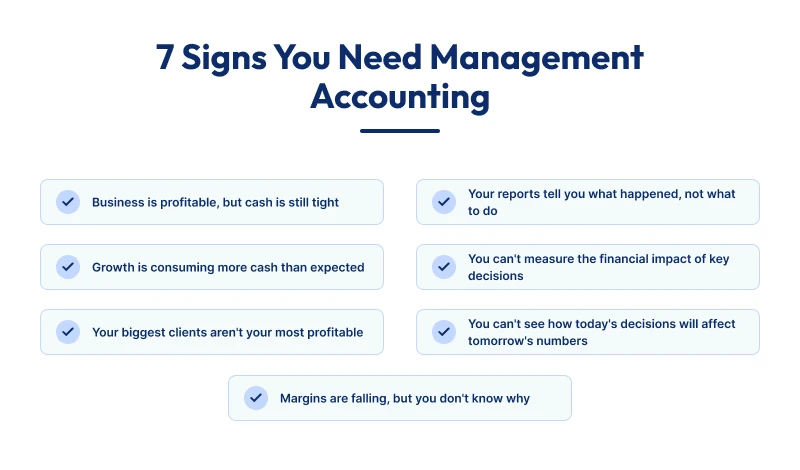
A P&L can show that revenue grew this quarter without explaining why margins fell or what that means for pricing going forward. Financial accounting records what already happened. Management accounting works out what’s driving it, so the numbers can inform the next decision instead of just describing the last one.
1. Profit is rising, but cash is not
The gap is usually tied up in receivables, inventory, debt repayments or working capital, none of which show up separately on the P&L itself. Management accounting connects the P&L, balance sheet and cash flow so you can see exactly where the cash is sitting instead of assuming it will catch up on its own.
2. Growth is putting pressure on cash
Each new sale usually requires more stock, labour or working capital before that cash actually lands in the account, so revenue climbing does not mean cash is keeping pace. Management accounting measures what growth is actually costing in cash terms and whether current funding can support the pace you’re growing at.
3. Your biggest clients are not your most profitable
Revenue by client is an average, and averages hide which relationships are actually worth keeping. Discounts, extended payment terms, support time and servicing costs can make a large client less profitable than a much smaller one, and that only becomes visible once profitability is broken down client by client.
4. Rising costs may actually be a pricing problem
When costs increase, cutting expenses looks like the obvious response, but if the price list no longer covers the true cost of delivery, trimming spend only goes so far. Breaking contribution margins and cost-to-serve down by product or service shows whether the real issue is spending, pricing, or both.
5. Management reports arrive too late to influence decisions
If last month’s numbers land halfway through the following month, they describe a problem that’s already happened rather than one you can still act on. Useful management accounting gets the relevant numbers in front of you while there’s still time to change the outcome.
6. Decisions are made without checking whether they worked
A new hire, a marketing campaign or a second location all rest on an assumption about the value they’ll create. If nobody checks that assumption against the actual result, the next decision gets made on a guess rather than evidence, which management accounting corrects by tracking the financial outcome of a specific decision against what was expected of it.
7. You can explain what happened, but not what happens next
Knowing last month’s revenue and costs is not the same as being able to model what a price increase, a drop in sales, or another round of expansion would do to the business. Forecasting and scenario analysis turn the numbers you already have into something you can test decisions against before committing money.
A quick test you can run on your own numbers
You don’t need all seven signs to show up before checking whether this applies to your business. Take any total on your P&L, revenue, cost of sales, or gross profit, and ask what happens to that number when you split it by client, by product, or by month instead of looking at it as one figure. If the answer is “someone would need to pull that together,” the total is hiding something. If the answer is “here’s how that breaks down,” it isn’t.
Try it on revenue first. A landscaping business doing $80,000 a month across residential maintenance, one-off garden builds, and a couple of commercial contracts sees one number on the P&L. Split by those three lines, the picture usually looks nothing like the total suggests. The commercial contracts might carry the best margin because they’re predictable and low-effort to service, while the one-off builds, despite bringing in the most revenue per job, might be eating margin through underestimated site time and material overruns that never get billed back. None of that shows up until the $80,000 gets split apart.
The same test works on cost of sales, marketing spend, or almost any line item. Split it by whatever actually drives the business, whether that’s client, service line, location or time period, and see whether the split changes what the number tells you. If it does, and getting that split takes manual work every time someone asks, that’s the gap this guide is describing. If a system already gives you that breakdown without extra effort, your reporting is likely already doing the job of management accounting, whatever it happens to be called.
What should management accounting actually add?
Professional management accounting should add analysis that helps you understand performance, plan ahead and weigh up the financial impact of a decision before you make it, at the level of detail the quick test above points to.
| Area | What it helps you understand |
|---|---|
| Cash flow and working capital | When cash will come in and go out, and where pressure may arise |
| Profitability analysis | Which clients, products, services or locations are contributing most to profit |
| Budgeting and forecasting | Whether performance is on track and how the outlook changes as assumptions change |
| Variance analysis | Where actual results differ from expectations and what is driving the difference |
| KPI reporting | Which financial and operational measures need management attention |
| Scenario modelling | How a proposed decision could affect profit, cash flow or margins |
The right mix depends on the business, but the objective is the same across all of them: numbers broken down finely enough to act on, not a longer report.
When does outsourcing management accounting make sense?
You don’t need a full-time management accountant on payroll to get this. Outsourcing tends to make sense when the business needs this level of analysis regularly enough to matter, but not so often that it justifies a permanent hire.
It can also make sense when:
- Your existing bookkeeper or accountant is focused on BAS, tax and compliance rather than analysis
- Management needs more detailed forecasting during a growth phase
- You’re preparing for finance, an investor round, or a sale
- Multiple entities, locations or revenue streams have made reporting harder to make sense of
- The owner or senior team is spending real time each month building their own analysis
- You need specialist support for a defined period without adding permanent headcount
Your existing bookkeeper or accountant doesn’t need to change. Management accounting sits alongside that function, using the same records while adding the analysis your team needs to act on.
Outbooks Australia can work alongside your existing finance team to provide management reporting, forecasting, profitability analysis and financial modelling, built around what your business specifically needs answered. The first step is identifying exactly where your current gap sits, so book a consultation or email info@outbooks.com.au to talk through what that looks like for your business.
FAQs
My accountant already sends me monthly reports. Is that management accounting?
It depends on whether those reports break the numbers down to the level your decisions are actually made at, not how detailed they look at a glance. A report showing totals by month or by the whole business isn’t management accounting in practice even if it’s called that; one with variance explanations, client or product-level detail and forward-looking scenarios likely already is.
Does management accounting replace my accountant or bookkeeper?
No. Bookkeeping and financial accounting keep the records accurate and support compliance and tax reporting. Management accounting uses that same information for internal analysis, planning and decision-making.
How do I know if I need a full-time management accountant or outsourced support?
Look at how much recurring analysis the business actually needs. If it’s regular enough to matter but not enough to justify a full-time role, outsourcing gets you the capability without the headcount.
How often should management accounts be prepared?
Monthly is the norm, but the right frequency depends on how fast the numbers move. A business with volatile cash flow or frequent major decisions may need more frequent updates than a stable one.
Can management accounting help with a specific business decision?
Yes. Scenario modelling can test a price change, a new hire, expanding to a new location, increasing marketing spend, or taking on additional finance before you commit to any of them.
Does outsourcing management accounting require new accounting software?
Not usually. A provider should be able to work with whatever system the business already uses, whether that’s Xero, MYOB or QuickBooks. Changing software should only happen if there’s a clear reason for it, not because a new provider prefers a different platform.